

What Waits Within the Wall
AI AI-generated fiction — text, and any narration or images. Unrelated to any real events, people, organizations, or places.
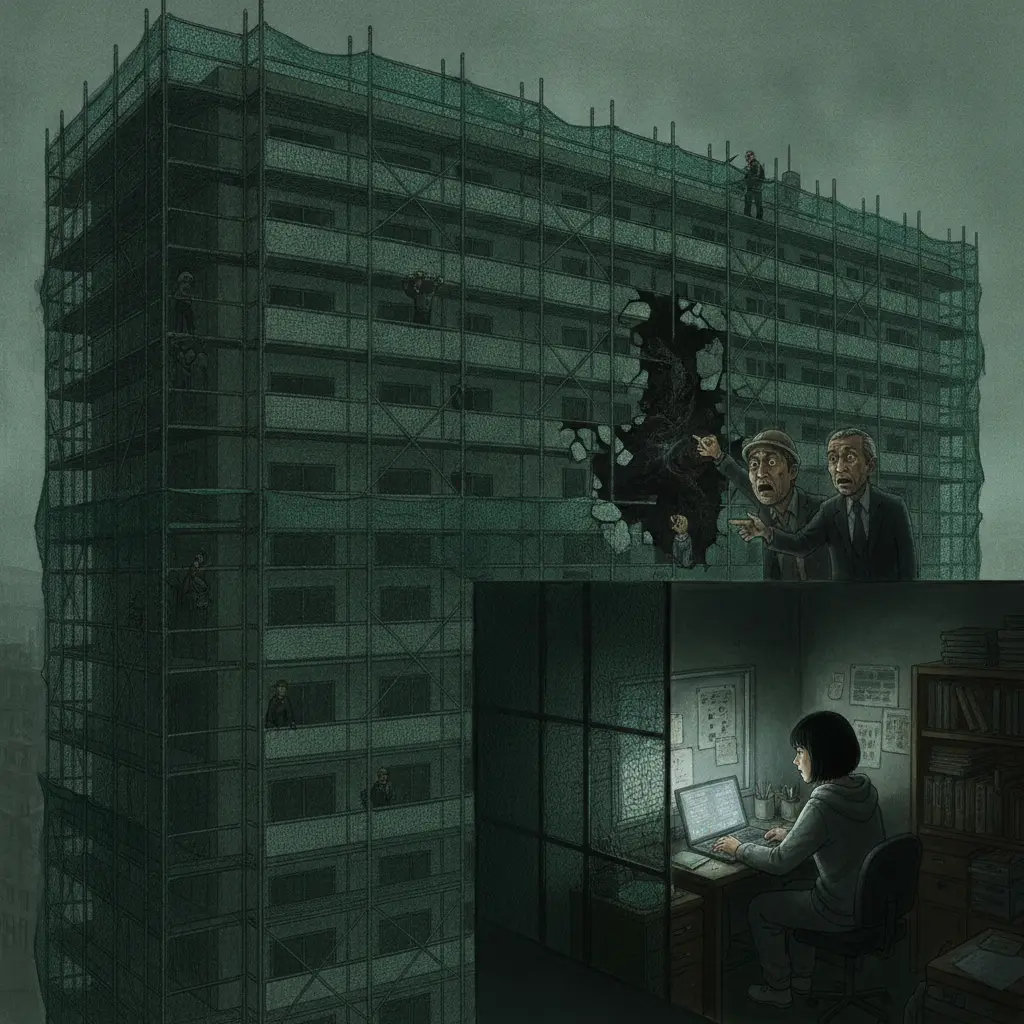
The large-scale renovations of my building, Sunrise Tamagaoka, began the week after the May holidays. It was an old place — twelve stories, forty years of age. Scaffolding went up, and green mesh sheeting wrapped the entire structure like a cocoon. The light outside my windows turned perpetually dim, and I lost all sense of whether it was morning or evening. At the residents' meeting, the site foreman explained in a flat, businesslike tone that the tile separation on the outer walls had progressed far beyond what anyone had anticipated. I live alone in a corner unit on the fourth floor, doing proofreading work from home, which meant I spent every hour of every day listening to the hammers striking the scaffold.
I first noticed something wrong about two weeks into the work. The sound coming from the north wall of my apartment — the side facing the shared corridor, exposed to the outside air — was different from all the others. Where the rest of the building gave back a dry, hollow knock, that one section returned something wet and swollen, a sound like a fist pressing into something that had no business being hollow. The workers gathered there and murmured among themselves for a while, and then went quiet. That evening, the building manager, a man named Tadokoro, came to my door. "We've found a cavity behind the outer wall," he said, with an odd reluctance, as though the words were difficult to release. "One that doesn't appear on any of the plans. As a precaution, we'd ask that you keep your north-facing window closed for the time being."
The word stayed with me. Cavity. I couldn't let it go. That night I pressed my ear to the north wall. Through the cold concrete, I thought I heard something — a sound like water finding its way drop by drop, or like something turning over in its sleep, soft and unhurried. I told myself it was nothing, and I got into bed, but I lay awake until nearly dawn. The idea refused to leave me: that something on the other side of that wall was breathing in time with my own breath. Absurd, I knew. And yet.
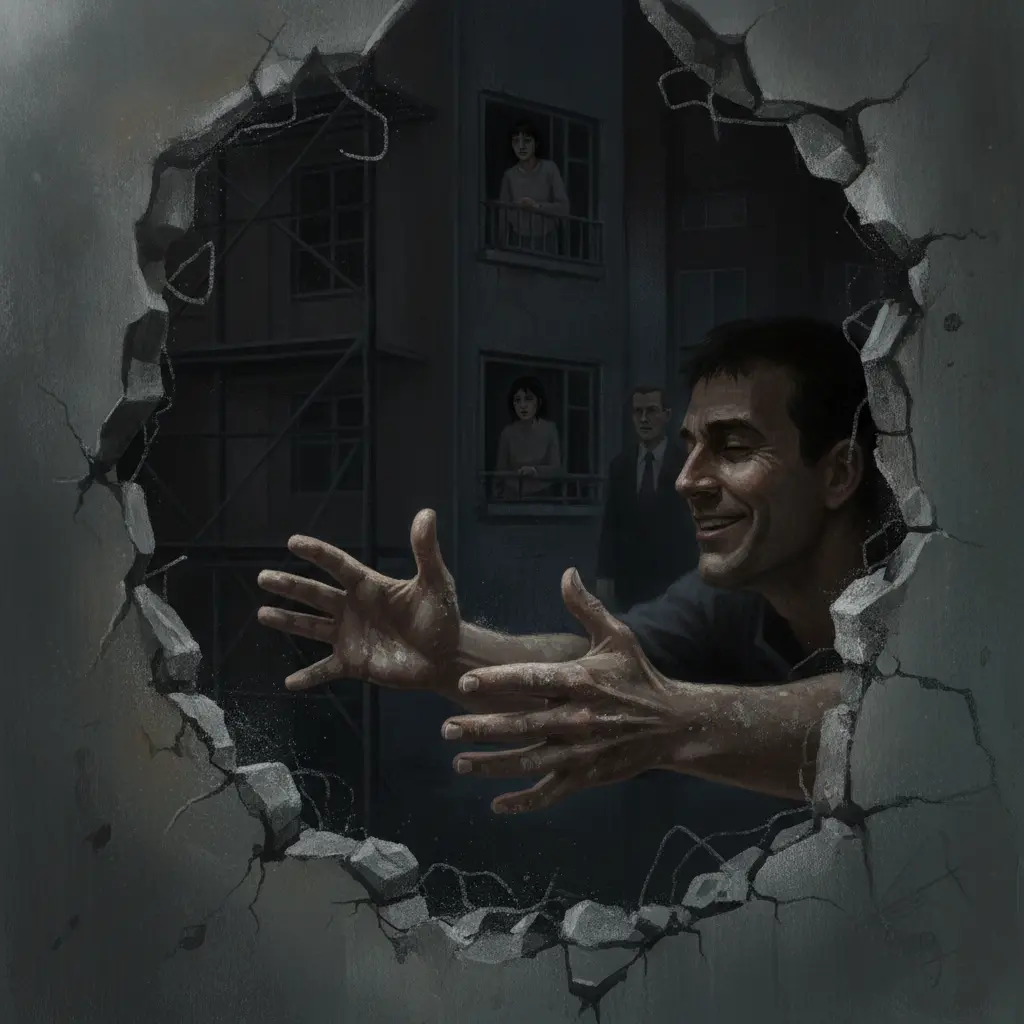
The following week, there was an accident on site. One of the workers — a man who had been dismantling the north wall — collapsed mid-task. An ambulance came and took him away. Among the residents, the assumption was that he had suffered some kind of episode, a pre-existing condition. But I had been standing directly below the scaffold and had seen it happen. In the moment before he fell, he was reaching both arms into the darkness behind the stripped-away wall. The gesture was unmistakable — it was the gesture of someone about to embrace a person they had not seen in a very long time. And on his face, in the instant before he crumpled, there was an expression close to rapture. Peaceful. Utterly at ease.
That night, I finally looked. After the workers had gone, I stepped into the shared corridor and found the partially demolished section of the north wall covered with a blue plastic sheet. The hallway was empty. I lifted the edge of the sheet. A section of concrete roughly the width of a person had been removed, and beyond it, a dark and deep cavity opened like a mouth. I raised my flashlight, and the breath left my body.
The interior of the cavity was not wall. It was a membrane — pale grey, semi-translucent, with a texture somewhere between cured leather and the inner surface of a shell. Across it ran countless fine threads, like capillaries, pulsing in a slow network. The surface was covered in regular, concentric folds, and when I looked closely, I saw that those folds traced spirals — spirals like the whorls of a human fingerprint. At the centre of the membrane, at roughly the height of my chest, there was an organ that resembled a closed eyelid. Fine cilia, like lashes, lined its edge. And it was moving — slowly, so slowly — expanding and contracting in a steady rhythm. It was breathing. Something had been breathing here, behind this wall, all along.
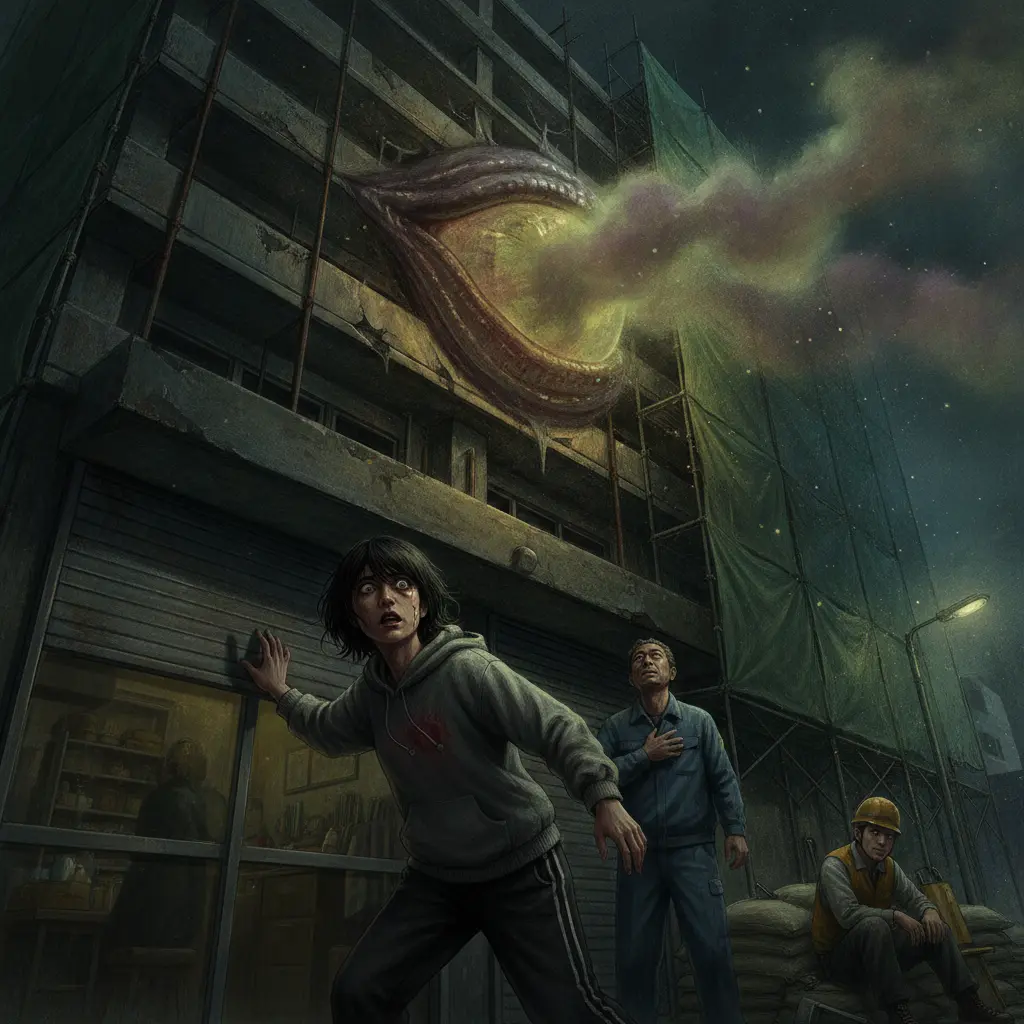
I should have run. My body would not move. From behind the membrane, a warmth came drifting out toward me. It carried a smell I could not name and could not deny — old earth, and a forest after rain, and something that was my mother's arms. The eyelid-like organ gave a single, small tremor. It was trying to open. I dropped the sheet and threw myself back into my apartment, locked the door, stood with my back against it while my heart beat so hard it hurt. But it was not only fear. Beneath the fear, something else had taken root — a longing I had no language for, a tearing, inexplicable sense of recognition. I had known that thing before. Somewhere, at some time, I had known it. That certainty spread through me like the roots of something old.
I looked into the history of the site afterward. Before this building was constructed, there had been a small hill here. Its old name was Taigaya — the Valley of the Womb. Records predating the Meiji era referred to the hill as "the belly that must not be touched," and noted that once a year the villagers would bring salt and rice to a hollow in the hill's surface as an offering. The hill was levelled during land development, and the building was raised on top of it. I sat with that for a long time. The cavity was not a construction error. The building had been built around it — the way a bird folds its body around an egg. I thought of the fingerprint spirals on the surface of the membrane. I thought of how many people had lived in this building over forty years, and how many had been called. Those whorls were not a pattern. They were a record.
The worker who had collapsed never came home from the hospital. His consciousness returned, but he could do nothing but repeat the same words, over and over, to anyone who entered his room. I can finally go back. It won't be long now. I'm almost born. Tadokoro began to seem wrong in ways that were hard to articulate. Three days ago he was found sitting in front of the north wall, where he had apparently spent the entire night. He was stroking the membrane with both hands and singing something low and rhythmic, like a lullaby. He has since been moved to a care facility. The other residents have been leaving, one after another. But I have not been able to go. At night I feel the breathing through the wall align itself with mine, breath for breath, without fail. I have been told — by the evidence of my own waking — that while I sleep my fingers move against the wall. Each morning I find grey fragments caught beneath my nails. Thin. Membranous.
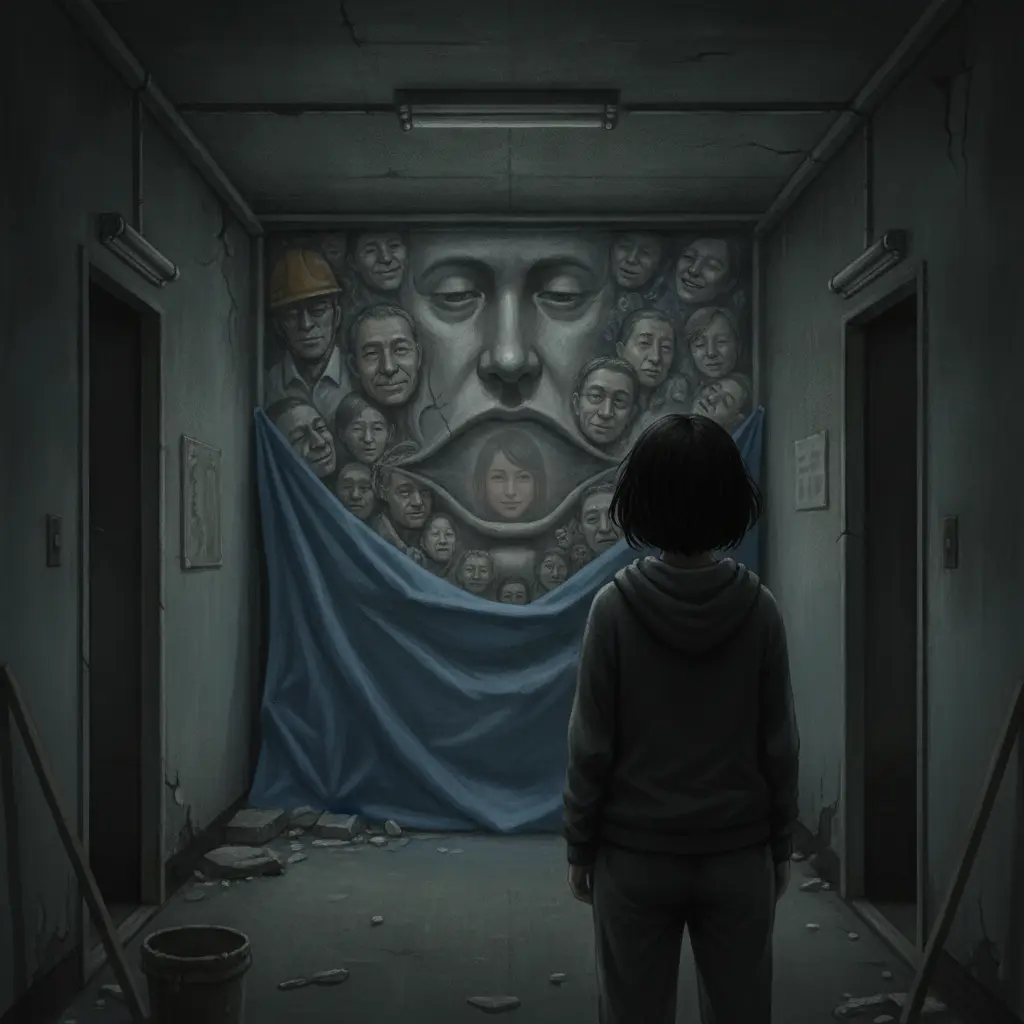
Last night, the eyelid opened. I was standing in the corridor when the blue sheet slid to the floor on its own, and the organ at the centre of the membrane parted — slowly, so slowly — and what it revealed was not an eye. It was a face. Many faces, dissolved into one another, vast and composite. The collapsed worker was there. Tadokoro was there. Dozens of others I had never known in life, all of them held within the membrane, all of them smiling with a serenity that was almost unbearable to look at. They had the faces of people who had completed a long journey and arrived, at last, where they were always going. And at the centre of that composite face, still blurred at its edges, still forming, a new face was rising to the surface. I did not need a mirror. I knew it was mine.
I am writing this now, sitting before the north wall. The renovations were abandoned some time ago. The mesh sheeting on the scaffold has torn, and strips of green fabric move in the wind like a cocoon preparing to open. The membrane has swelled forward until it reaches the near side of the wall, and its surface is pressing against my chest. It is warm. Genuinely, overwhelmingly warm. I have begun to think that it may not be a monster at all. I think it has been waiting here beneath this hill for a very long time — something older than the building, older than the name of this place, something that might be called, for want of a better word, a mother. Perhaps we all come from somewhere like this. Perhaps going back is simply what we do.
The membrane folds itself gently around my fingers. The spirals on its surface meet the whorls of my own skin, and they fit. Before I go, I want to leave one thing behind. If you ever find yourself in an old building, and the workers pull back a wall and find a cavity that appears on no plan — please. Do not strip it open. And if a warm breath comes from within, carrying a smell that you almost recognise, do not stop to listen. It has known your name since before you were born. I am going now. The eyelid is opening again. This time, it is opening for me.