

The Back of a Figure
AI AI-generated fiction — text, and any narration or images. Unrelated to any real events, people, organizations, or places.

Minjun's trip to Daegu had been entirely accidental. Five years into his career as a freelance photographer in Seoul, he found himself in the grip of his first prolonged creative drought, and so he packed a single bag and boarded a train with no particular destination in mind. What he remembered most about stepping onto the platform at Dongdaegu Station was the weight of the late-autumn air — how it pressed against him, heavier than it should have been. He spotted a sign near the station exit that read "Bangcheon Market · Kim Gwang-seok Street," and felt a vague, sourceless familiarity at the name. Perhaps someone had mentioned it to him once, or perhaps it simply rang in his ear the way an old song title does — half-remembered, half-imagined.
He transferred to a bus and got off near Bangcheon Market, where murals lined the entrance to the alley one after another. The late-afternoon sun fell at an angle across the silhouette of a guitar-playing man painted on a low wall. Minjun raised his camera. Through the viewfinder, the alley held a color that was at once cozy and faintly sorrowful. Small cafés and craft shops ran along both sides of the street, and from somewhere a song drifted out of a speaker, low and unhurried. The voice was warm and deep, but it carried the quality of something that belonged to a person no longer in the world. Minjun pressed the shutter. The light was good. The street was beautiful. He planned to stay two nights and return to Seoul.
His accommodation was a small guesthouse tucked around a corner at the far end of the street. The woman who ran it appeared to be in her early fifties, and throughout the entire check-in process she did not once meet his eyes. His room was on the second floor. From the window he could look down at the tail end of Kim Gwang-seok Street, and after dark the murals took on entirely different faces in the glow of the streetlamps — nothing like what they had been in daylight. Minjun unpacked and stood at the window for a long while, watching. The music from the speakers did not stop when evening came. It seemed to be cycling through the same album, over and over.
The first night passed without incident. He walked the street slowly, taking photographs: couples posing in front of the murals, a potter visible through a workshop window, and a single worn chair left at the corner of an alley. The chair caught his eye more than anything else. A guitar was painted on its backrest, and a small placard in front of it bore words that looked like song lyrics. Minjun raised his camera toward it, then paused. Through the viewfinder he noticed something odd — the cushion was depressed, as though someone had only just risen from it. But there was no one nearby. He told himself it was fatigue.
The following morning he rose early and went out to shoot while the street was still empty. He had noticed the evening before that the murals on the Bangcheon Market side changed color entirely in morning light. The alley was deserted; the shops had their shutters down. The speakers were silent. For the first time since he'd arrived, the street was completely quiet — so quiet that his own footsteps seemed to bounce back at him off the walls. He moved from mural to mural, framing each one: the man with the guitar, the musical notation carved into a wall, the figures walking with bowed heads. Then he stopped in front of a mural he was certain had not been there the evening before.

Unlike the others, this one had been made with rough, uneven strokes — as though painted not with a brush but with bare fingers, the dark pigment applied thickly and unevenly. The figure depicted was shown from behind, but what made it strange was not the pose itself. It was the orientation. The figure did not appear to be standing facing the wall. It appeared to be coming out of it. The outlines curved outward, as if pressing through the surface, and the feet were rendered with a warped perspective that suggested they had already crossed to this side. Minjun studied the image for a long moment, then raised his camera. The instant he pressed the shutter, he had the distinct impression that the figure's head had turned — just slightly — within the viewfinder. He lowered the camera and looked at the mural with his bare eyes. It was unchanged. A figure seen from behind. Coming out of the wall.
Back at the guesthouse, he transferred the morning's photographs to his laptop. Something was wrong. The image of the new mural — the one he was certain he had shot — was not there. He remembered pressing the shutter clearly, and yet the file did not exist. Everything else was present: the man with the guitar, the musical notation, the bowed figures. Only the image of the figure from behind was missing. He removed the memory card, reinserted it, and relaunched the software. The result was the same. He decided it was a card error and resolved to go back and shoot it again. But when he returned to the alley that afternoon, the wall where the mural had been was bare. Not freshly painted over — simply bare, the old plaster undisturbed, as though nothing had ever been drawn there at all.
That evening Minjun stepped into one of the street's cafés and ordered something warm. Music played from a speaker inside as well. He found himself listening to the lyrics, and a particular line snagged in his mind: something that translated, roughly, as I'm still here, I'm still here. He couldn't say whether those were the actual words or not — he had never listened closely to this music before. At the next table sat a woman alone, and she seemed to be listening too; her eyes were closed, her lips moving almost imperceptibly. On an impulse, Minjun lifted his camera and brought the viewfinder to his eye. Then his hand went still. Behind the woman, on the wall, something was there. Faint but unmistakable — the same figure, leaning against the wall. He lowered the camera. The wall was empty. He raised it again. The figure reappeared.
Minjun stood, paid, and left. Outside, the cold evening air struck his face. People moved along the street in both directions. The music continued. He steadied his breathing and walked slowly. Rounding a corner, he passed the old chair again. This time the cushion was undisturbed. But on the ground beside the chair, in the thin layer of dust that had settled on the pavement, there were footprints. Clear, distinct impressions leading from the chair toward the wall. They ended where the wall began. There was no door in that wall. No window. Only concrete.
Back in his room, Minjun sat on the bed and went through every photograph from the day. The ones from the café. The ones from the street. He turned through them one by one, and then his hand stopped. There was an image he had no memory of taking. It showed the second-floor corridor of the guesthouse. In front of the door to his own room stood a figure, seen from behind. It wore an old coat. Its face was turned toward the door. One hand rested on the handle — whether about to open it or already in the act of doing so, he could not tell. He checked the file's timestamp. Seven forty-two that evening. He had been in the café.
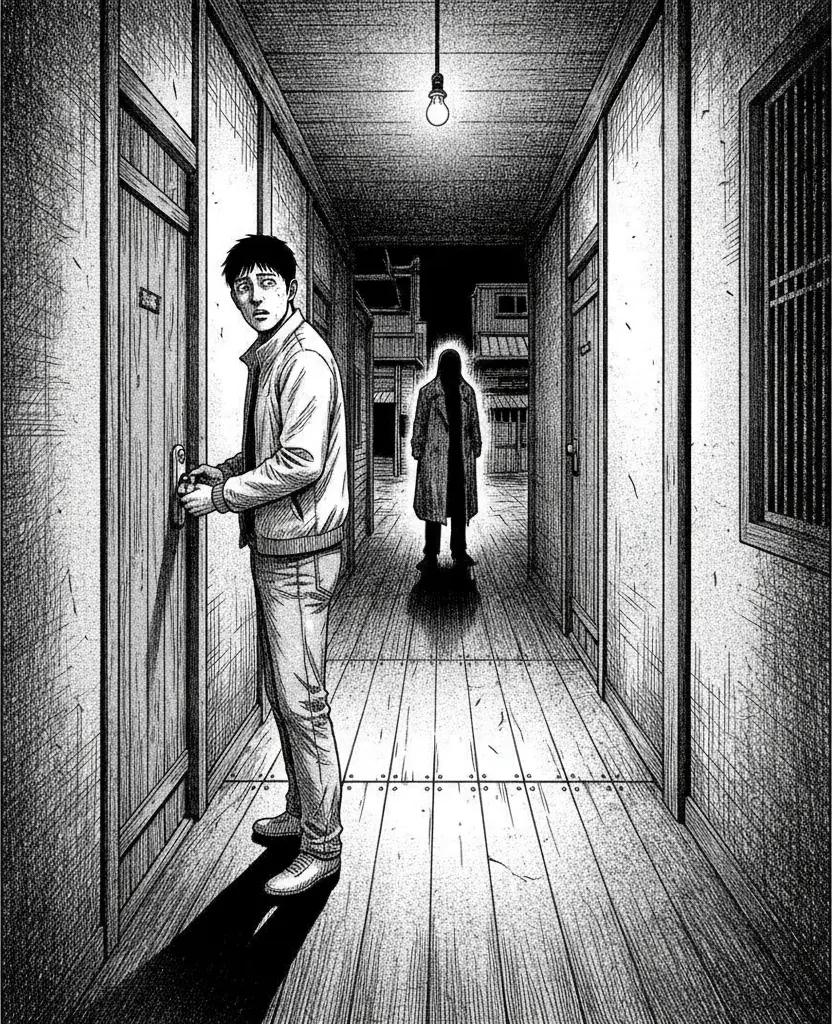
Minjun went downstairs and asked the owner whether any other guests had been on the second floor that evening. The woman looked directly at him for the first time. Her gaze had an unusual weight to it. "You're the only one on the second floor," she said. Then, after a brief hesitation, she added: "But why were you taking photographs up there?" Minjun had no answer. The woman said nothing more, and the silence that followed seemed to fill the entire room. He went back upstairs and locked his door.
He did not sleep. Through the wall came sounds — or what might have been sounds. Music, perhaps, or someone murmuring at a very low register. It was not coming from the direction of the door. It was coming from the wall itself. He lay with his hands pressed over his ears, and eventually gave up, switched on the light, and opened his laptop. He began going through the photographs from the very beginning — the murals from the first evening, the chair, the alley. And this time he saw something he had not seen before. In the background of the street photographs — somewhere in each of them — the same figure appeared. Very small. Tucked among the other people, or standing in the deep shadow at the far end of an alley. It was there in the first photograph he had taken. From the moment Minjun had first set foot on this street.
Something clicked into place. The figure in the mural. The figure on the café wall. The figure in the corridor photograph. The figure in the background of every single image. They were all the same. And they were all seen from behind. Not once had it shown its face. Always moving toward something, or emerging from something — a back turned, a direction implied. And then Minjun understood that the figure had not been following him from the beginning. It was the other way around. He had followed it here. That sense of familiarity he had felt reading the name on the sign at Dongdaegu Station — it had not been a memory. It had been a pull.
That night Minjun packed his bag. He would take the first bus to the station before dawn and catch the earliest train back to Seoul. When he had finished packing he looked around the room once more, then glanced out the window at the street below. It was past midnight, but the music from the speakers was still playing. The street was empty. The murals glowed yellow and red in the lamplight. He was about to turn away when he stopped. At the far end of the street, where the light did not reach, something was standing in the dark. A figure, seen from behind. This time there was no viewfinder between them. He was looking with his bare eyes, and he could see it clearly. And slowly — very slowly — it began to turn its head in his direction.
Minjun pulled the curtain shut. His heartbeat filled his ears. He picked up his bag and stood before the door. He gripped the handle. His hand would not move — and it was not only fear that stopped him. It was the temperature of the handle itself. It was warm. Warm in the way a handle is warm when someone on the other side has been holding it. The warmth of a living hand. He held his breath and slowly turned it. The door opened. The corridor was empty. The overhead light was flickering. He descended the stairs one step at a time and let himself out through the front entrance.

Outside, the silence was absolute. The alley at two in the morning was a different world from what it had been in daylight. The murals seemed alive in the lamplight. Minjun kept his head down and walked quickly — toward Bangcheon Market, toward the main road. He told himself not to look back. His footsteps rang through the alley. Then, beneath his own footsteps, he heard another set. One beat behind, following. He walked faster. The other steps quickened. He stopped. The other steps stopped. His heart rose into his throat. He decided not to look back. He ran.
When he reached the main road the streetlights were bright, and in the distance a taxi was passing. He flagged it down and got in. Dongdaegu Station, he said. As the car pulled away he looked back through the window at the mouth of the alley. There was nothing there. Only the boundary between darkness and light. The music faded as they drove, and for a moment a line of lyric reached him through the glass: I'm still here, I'm still here. Minjun closed his eyes. He did not open them again until he was at the station.
After returning to Seoul, Minjun opened the photo folder one last time. He had decided to delete everything he had taken in Daegu. He went through the files one by one, removing them. Then he reached the last file. The filename was a meaningless string of numbers, and the timestamp placed its creation during the time he had been on the train out of Dongdaegu. He opened it. It was not a photograph. It was a video. When he pressed play, the screen showed the second-floor corridor of the guesthouse, shot from an unfamiliar angle. The light was flickering. The door to his room stood half open. And inside the room — the room as it had looked before he finished packing — someone was standing at the window, looking out. A figure seen from behind. An old coat. Its head was tilting slowly downward, toward the street below. The video was thirty seconds long. Minjun watched all thirty seconds. The figure never once turned from the window. In the final frame, just before the recording ended, the head shifted — just slightly — in the direction of the room's interior.
Minjun deleted the file and closed the laptop. The room was quiet. Seoul at night was louder and brighter than Daegu had been. He lay down on the bed and stared at the ceiling. When he closed his eyes the alley lights came back to him, and the song repeated itself somewhere behind his thoughts. Sleep would not come. Around three in the morning he reached for his phone out of habit and opened the camera roll. There was a new file at the top. It had been taken moments ago. He stared at it for a long time, his thumb hovering.
He thought he already knew what it would show. So he did not open it. But he did not delete it either. He turned the phone face-down on the bed so the screen was hidden, and closed his eyes. The song was still moving through him — low and warm, like a voice insisting, gently and without urgency, that it was still here. That it had always been here.