

Afterimage of Osorezan
AI AI-generated fiction — text, and any narration or images. Unrelated to any real events, people, organizations, or places.
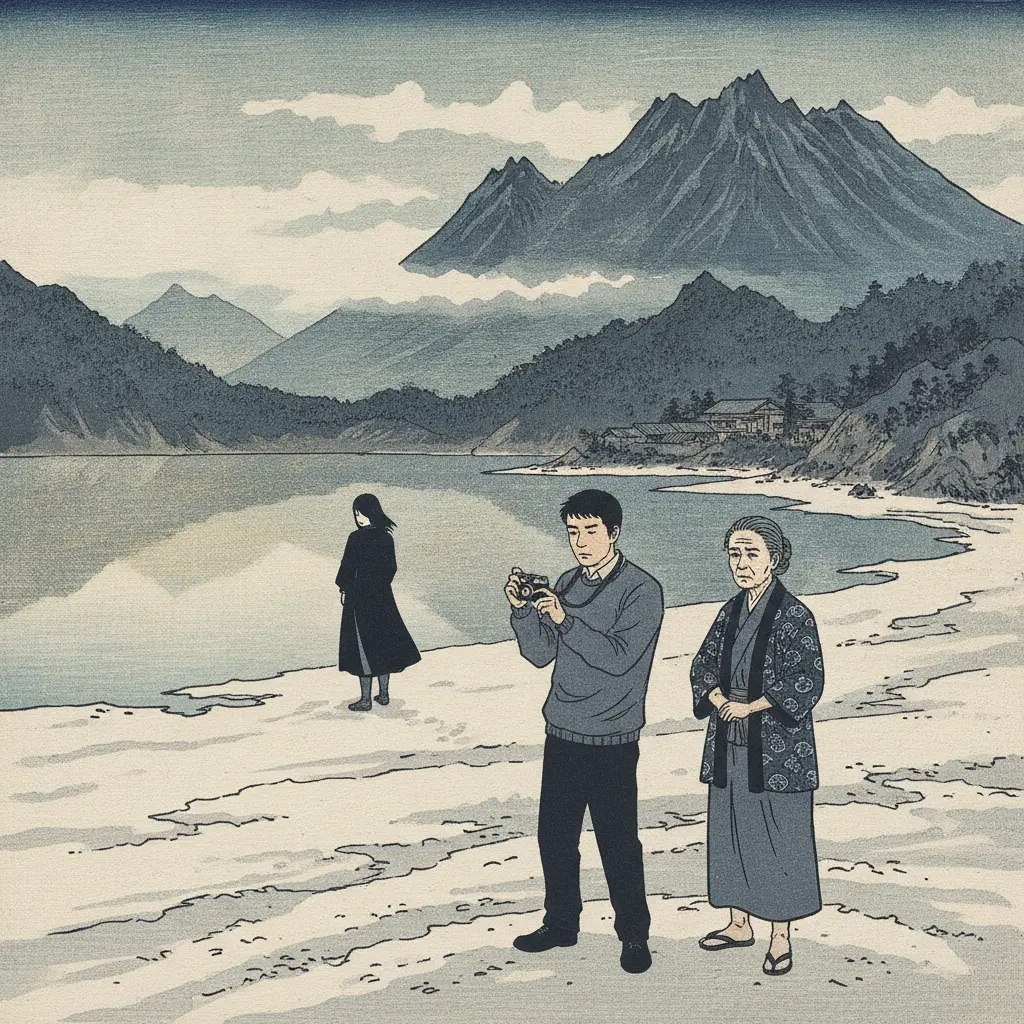
At the foot of Osorezan, a man took a photograph.
That was all it was, at first.
---
Miura Shin'ichi (三浦慎一) set out for Osorezan at the end of September, when the tourist season was drawing to a close. A freelance photographer based in Tokyo, Shin'ichi was, at forty-two, experiencing his first true creative drought. Magazine assignments had dried up, plans for a gallery exhibition had quietly dissolved, and in the past six months he had not taken a single photograph that made even himself catch his breath. He told his wife Kumiko only that he was going away for a while, slung a camera bag over one shoulder, and boarded a overnight bus bound for Aomori.
He got off at Ominato, at the base of the Shimokita Peninsula, and rented a car. As he drove north along the prefectural road, the landscape slowly changed its face. First the conifers deepened in color, then the houses grew farther apart, and at last all trace of human presence vanished from either side of the road. When he turned onto the mountain pass known as the Osorezan Highway, a faint smell of sulfur drifted in through the car window — something like rotten eggs, but older and damper than that. Breathing it in, without even raising a viewfinder to his eye, Shin'ichi felt an instinctive certainty: this place could be shot.
He dropped his bags at the inn just before the temple gate, at the far edge of the Osorezan hot-spring hamlet, a little after noon. The inn was called Yumori-kan — a two-story wooden building, white walls crossed by dark beams. The proprietress who came to greet him was a slender woman in her sixties, not unfriendly, but with eyes that seemed to be quietly appraising him. When Shin'ichi said he had come to take photographs, she paused for just a moment before answering, "Is that so." He could not quite read what that pause meant.
His room was a corner room on the second floor, with a window that looked out onto a portion of Lake Usoriyama. The surface of the lake was whiter than the sky, as though light were seeping upward from somewhere beneath it. Shin'ichi took out his camera and shot a frame immediately. Through the viewfinder, the lake appeared even whiter than it did to the naked eye, flatter, more without depth. Good. Genuinely good. And yet something was missing. Unable to name what that something was, he went on pressing the shutter.
---
Late that first afternoon, Shin'ichi walked to the temple gate. The grounds were closed, but from outside he could see the sulfurous vents in the rock. The earth was stained yellow-white; small cairns of stacked stones trembled in the wind, and beside them faded pinwheels had been pushed into the ground. The pinwheels were not turning. There was wind — but they were not turning. After shooting more than ten frames of one pinwheel, Shin'ichi moved closer to see why, and understood: thin wire had been wound carefully through the blades. Someone had stopped it deliberately. He could think of no reason why anyone would do such a thing.
Back at the inn, Shin'ichi was the only guest at dinner. A single tray had been set in the wide dining room — salted char, simmered mountain vegetables, miso soup with local tofu. As he ate, he scrolled through the day's photographs on the camera's LCD. The white of the lake. The yellow of the rock face. The shadows of the cairns. None of it was bad. Yet with each image a faint unease accumulated somewhere inside him, and he could not identify its source. He finished eating, returned to his room, transferred the files to his laptop, and looked at them on a larger screen. Then he understood.
Every photograph contained a person.
Or rather, something like a person. In the background of each frame, without exception, there was a blurred outline — a single vague shape. In the lake photograph, a figure stood at the far right of the white water, its back turned toward the camera. In the rock-face photograph, something crouched in the depths behind a sulfurous vent. In the pinwheel photograph, a long thin shadow lay across the ground beside the pinwheel — but whatever had cast it appeared nowhere in the frame. Shin'ichi tried to remember being there. There had been no one. He was certain of it. The off-season, no other tourists anywhere in sight.
He spent thirty minutes going through every photograph, checking each one for the presence of these shapes. Twenty-four of the twenty-seven frames contained something.
He did not sleep easily that night. But he refused to call what he felt fear. It was a photographer's curiosity, a low tremor of excitement, and something else he did not want to name. Outside the window, Lake Usoriyama glowed white in the dark.
---
The next morning, Shin'ichi showed the proprietress the photographs he had taken. She put on her reading glasses and studied each image on the laptop screen, one by one, with no particular sign of surprise. "They came out well," she said.
"What are these?" Shin'ichi asked. "These shadows. These things that look like people."
The proprietress was quiet for a moment, looking at the last photograph — the one where only a shadow lay beside the pinwheel, with nothing to cast it.
"People who come here," she said slowly, "find that there are things they try to capture and cannot, and things they never tried to capture at all."
She said nothing more, and took off her reading glasses. When Shin'ichi tried to ask a follow-up question, she said, "It's a fine day again today," and went back to the kitchen.
Shin'ichi entered the temple grounds that morning. On a weekday at this time of year, the worshippers were few — one elderly couple, and a young woman walking a little ahead of him. She wore a black coat and carried nothing. Too little luggage for a tourist. And her gait, for a local, was somehow wrong. She made no sound. She was walking on gravel, yet her feet produced no noise at all.
Shin'ichi raised his camera and shot her from behind. An instant later she turned a corner and was gone. He hurried after her, but there was no one on the other side — only the spread of volcanic rock, white sulfur rising in thin columns, and the rows of cairns.
Back at the inn at midday, he checked the photograph. The woman in the black coat, seen from behind. But from the neck up, she was covered in a flat white haze. It was not a focus problem — the folds of her coat were perfectly sharp. Only above the neck, with unmistakable clarity, there was simply white. As though her head had not been there at all.
Something solidified at the back of Shin'ichi's throat.
---
On the morning of the third day, Shin'ichi was dreaming before he was fully awake.
In the dream he stood at the edge of the lake. He knew it was Lake Usoriyama by the whiteness of the water. Along the shore, hundreds of cairns stood in rows, each one topped with a pinwheel. But every pinwheel was still — not held by wire, but by something else. Looking closely, he saw that fingers were caught between the blades. Thin, bluish-white human fingers.
In the dream, Shin'ichi raised his camera. The lake filled the viewfinder. And in the center of the lake, something floated. No — stood. It was standing on the water, facing him. He could not see its face. Not because of the distance, but because the area where a face should have been was white and blurred, even within the dream.
Shin'ichi pressed the shutter.
At that instant, he woke.
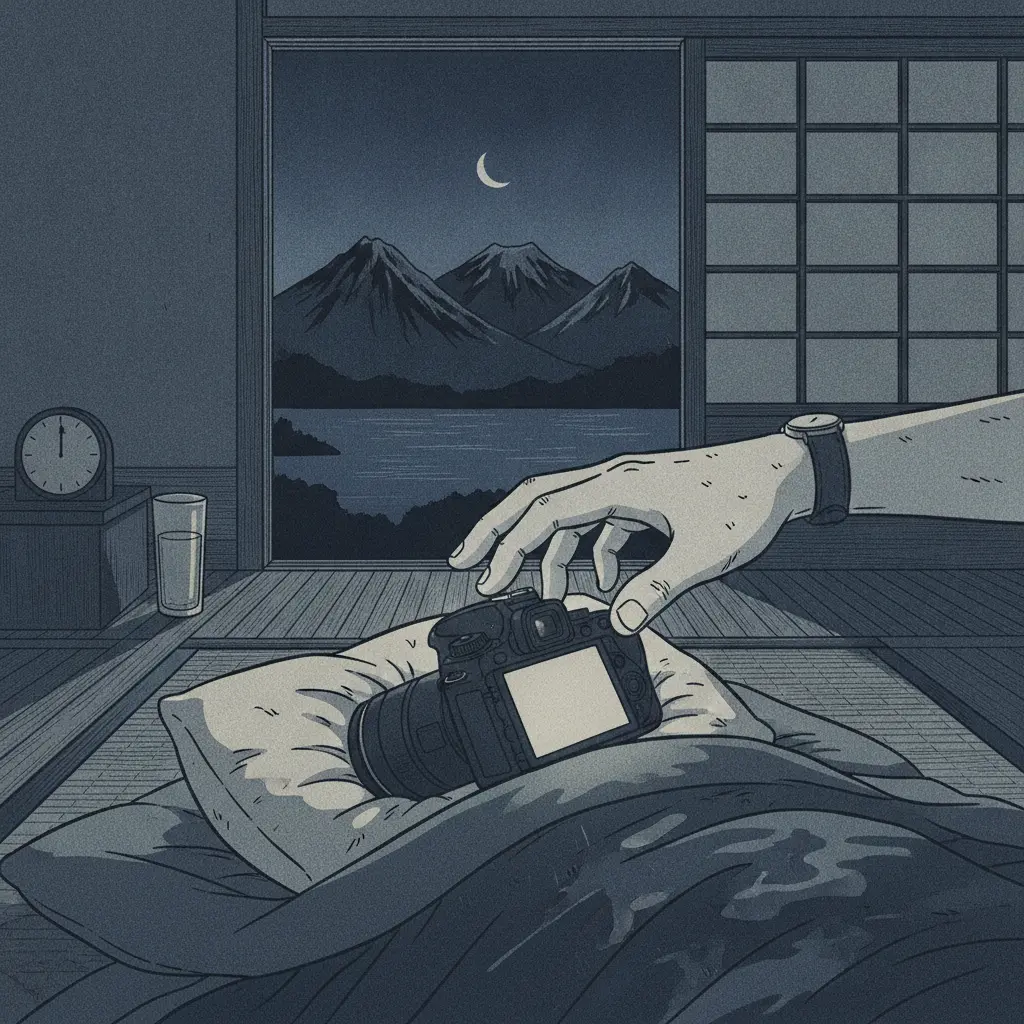
He was soaked in sweat. The window was still dark; the clock read three in the morning. He reached for a glass of water and touched the camera on the nightstand. Then he noticed. The shutter count was twenty-three higher than it had been before he fell asleep.
With trembling hands, Shin'ichi pressed the playback button.
The first frame was a photograph of the ceiling. His own ceiling, in this room. The second was the window — the darkness outside glowing white through the curtains. The third was the corridor. The room door stood slightly ajar, and the dark hallway stretched away beyond it. Then the staircase. Then the inn's entrance. Then the road outside. Then the mountain path. Then —
The lake.
Identical in composition to what he had seen in the dream. The cairns along the shore. The motionless pinwheels. And in the center of the lake, something white and blurred, unmistakably standing.
Shin'ichi tried to tell himself he had been sleepwalking. That he had carried the camera out while unconscious, walked to the lake, taken the photographs. He tried to make himself believe it. But his shoes sat where he had left them, clean of mud. His slippers had not moved. His pajamas were spotless.
When he looked at the twenty-third and final photograph, his thoughts stopped entirely.
It was a photograph of his own sleeping face. He lay on the bed, eyes closed, and the shot had been taken from directly above, or from directly beside him. The composition was perfect. His expression was peaceful, his eyes shut, and the photograph conveyed the sense of a man breathing.
But on the pillow beside him, a long thin shadow had fallen. Whatever had cast it stood outside the frame.
---
At breakfast, Shin'ichi told the proprietress everything. The dream. The shutter count. The final photograph. She poured tea in silence and listened to the end, then exhaled once, slowly and deeply.
"There was someone last year," she said, "who told me much the same thing."
"What happened to them?" Shin'ichi asked.
The proprietress was quiet for a moment. "They went back to Tokyo," she said, and then, after a brief pause: "But we lost touch with them after that."
Shin'ichi decided he would leave immediately. Pack his bags, get in the rental car, drive back to Ominato, take the bus to Tokyo. But the next thing the proprietress said nailed him to his chair.
"They say it's worse after you leave."
"Worse — how?"
"In the photographs," she said. "Even after you've gone, it appears in everything you shoot. You have to face it properly here, while you still can."
Shin'ichi looked at her face. She did not look away. In her eyes there was neither pity nor fear — only something old and level, quietly settled there.
"How does one face it?" he asked.
"You photograph it," she said. "Head-on. Without running."
---
That afternoon, Shin'ichi stood at the edge of the lake.
The sky was clear. But the contrast between the blue above and the white below was sharper than the day before, as though a single layer of skin had been peeled from the surface of the world. He walked along the shore with his camera over his shoulder. The rows of cairns continued. The pinwheels stood in lines. Today they were turning — all of them, in the same direction, making a dry clicking sound.
He walked and shot. When a figure appeared in a frame, he did not turn around. When only a shadow lay on the ground with nothing to cast it, he did not stop. When something with a white blur where a face should have been drifted into the viewfinder, he did not lower the camera.
At the eastern end of the lake, he stopped.
The woman in the black coat was standing at the water's edge.
She was not facing away from him. She was facing toward him.
For the first time, Shin'ichi saw her face.
She had one.
That, more than anything, was what frightened him.
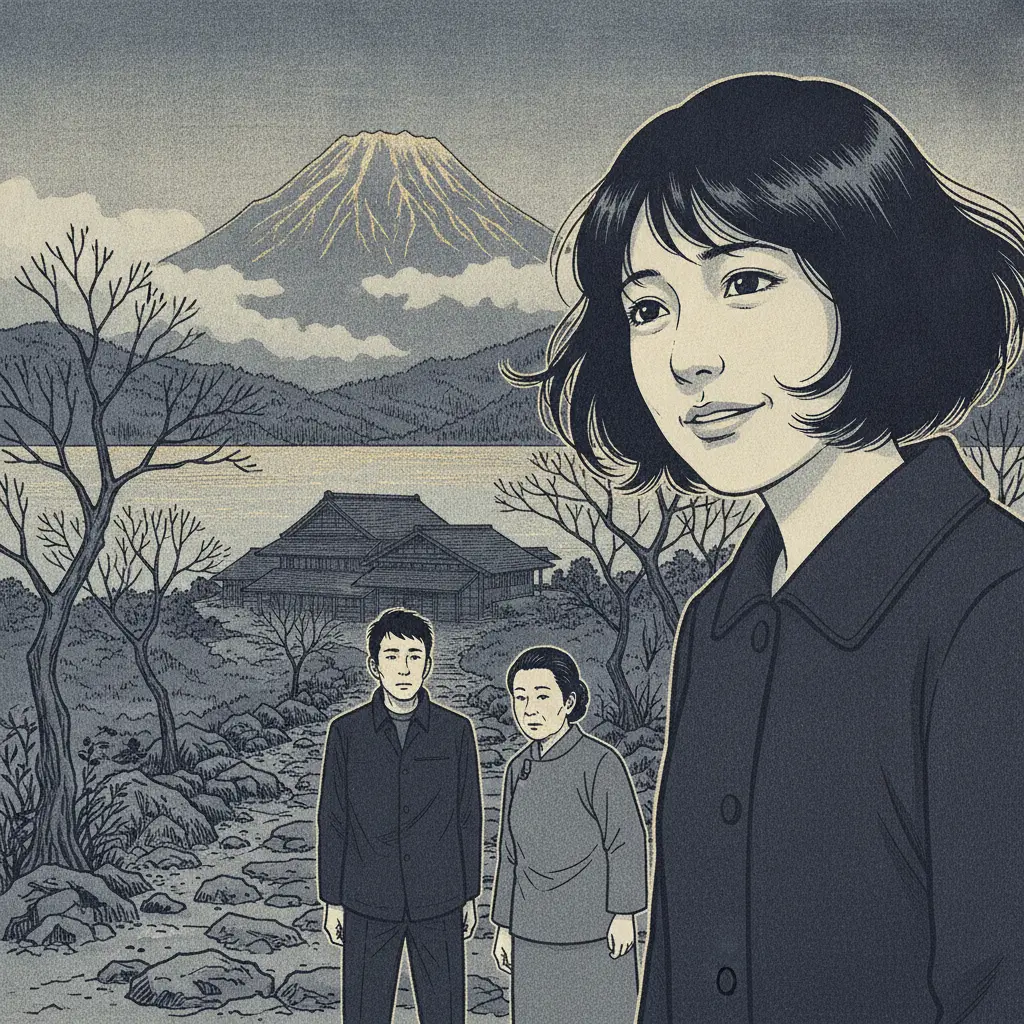
It was a composed face — an ordinary Japanese woman's face, perhaps in her thirties. Her expression was impossible to read: she might have been crying, or smiling, or both at once. The one thing he knew for certain was that her eyes were not looking at his camera. They were looking at his face.
Shin'ichi pressed the shutter.
The woman vanished.
A single strong gust of wind swept in from somewhere, and every pinwheel along the shore stopped at once.
---
Back at the inn that evening, Shin'ichi checked the photographs.
The woman in the black coat, shot from the front. Her face was clearly visible — that expression that could not be called crying or smiling. He looked at the photograph for over a minute before he noticed something.
Behind the woman, the lake was visible.
In the white of the water, a cairn could be seen.
On top of that cairn, a pinwheel had been pushed.
Through the blades of that pinwheel, thin bluish-white fingers were entwined.
Shin'ichi enlarged the image. Enlarged it further.
Five fingers. But the number of knuckles on each was one more than a human hand possesses.
---
That night, Shin'ichi called Kumiko.
"Are you all right?" she said. "Getting any good shots?"
"I am," he said. "Really good ones."
"I'm glad," she said. "Your voice sounds a little strange, though. Are you okay?"
"I'm fine," he said. "I'll be home tomorrow."
After he hung up, Shin'ichi sat at his laptop and went through every photograph he had taken over the three days, one by one, from the first to the last. The white of the lake. The yellow of the rock. The stopped pinwheels. The back of a black coat. A ceiling. A corridor. Something white standing on the water. His own sleeping face. And today's — the woman's face, shot head-on.
One hundred and forty-seven frames in total.
He gathered them all into a single folder and gave it a title: Osorezan, September. He backed it up to an external hard drive and closed the laptop.
He could not sleep. But that night, he did not dream.
---
The next morning, Shin'ichi checked out. The proprietress came to the entrance to see him off. He thanked her and said he would come again. She said, "Please do," but something in her expression held a reservation.
"May I ask you one thing?" Shin'ichi said. "The person who came last year — you said you lost touch with them. Does that mean —"
"A photographer," she said. "About your age. They left their camera here."
"Left it here?"
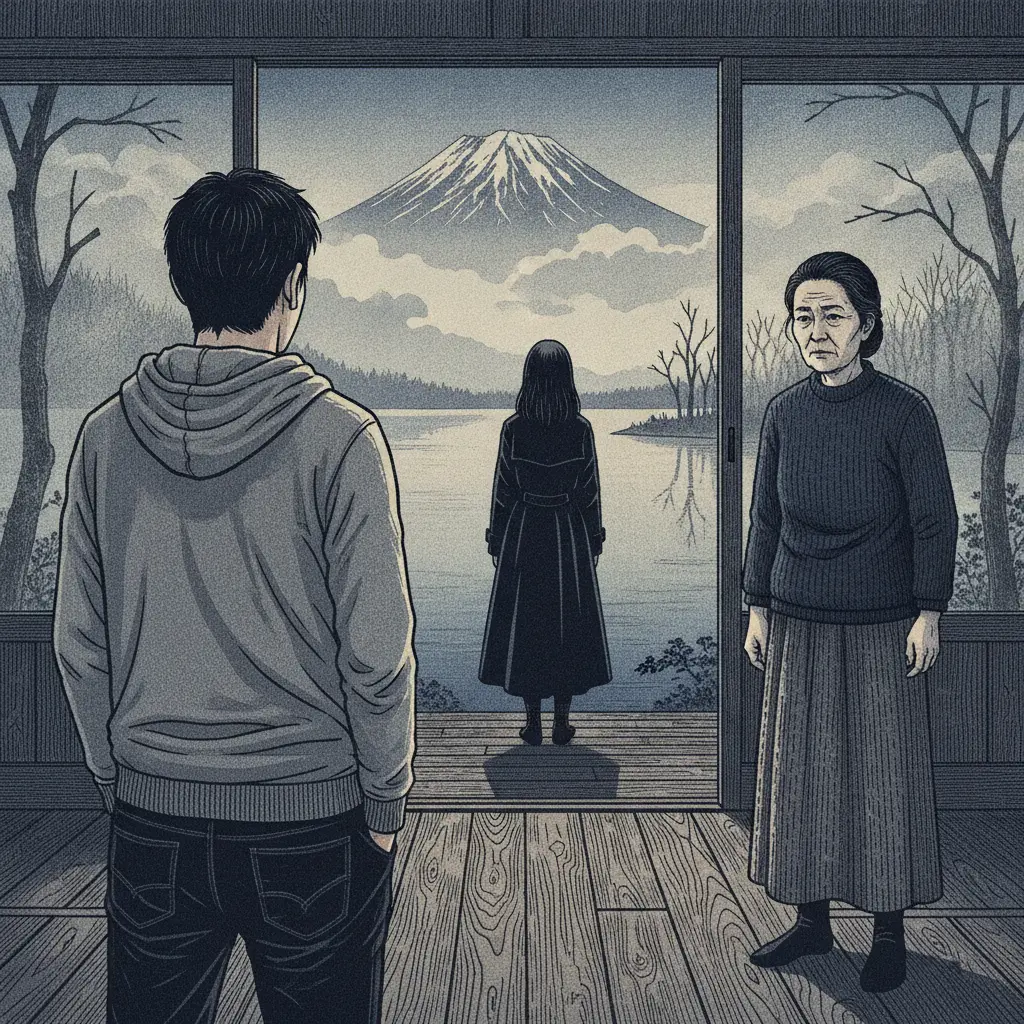
"Said they couldn't bring themselves to take it home." She paused briefly. "But they took the photographs with them."
Shin'ichi tried to work out what that meant, and could not. He started the rental car and began descending the mountain road. In the rearview mirror, the white walls of the inn grew small and disappeared.
He cleared the Osorezan Highway, reached the flatlands, and turned onto the prefectural road toward Ominato. He reached into the camera bag on the passenger seat, feeling for his camera.
There were two cameras in the bag.
He pulled over to the side of the road and looked inside. His own black camera. And another — an older model, its body yellowed with age. A small strip of tape on the strap bore someone's name, but the tape had faded in the sun and the writing had bled into illegibility.
Shin'ichi took out the old camera and turned it on.
The battery still had charge.
He pressed the playback button. A photograph appeared.
The first frame: a residential street somewhere in Tokyo.
The second: the interior of a room — an ordinary room, with the look of someone's daily life.
The third: someone's sleeping face.
Shin'ichi stared at the screen. He recognized that sleeping face.
It was his own.
Taken in the exact same composition as the photograph his own camera had taken of him the night before.
But this camera had not been in his room last night.
---
Shin'ichi sat in the car for a long time. Outside the window, the autumn wind of Shimokita moved through the dry grass. The sky was high and blue and reflected nothing.
At last he set the old camera on the passenger seat and took out his own. He raised the viewfinder to his eye and looked out at the landscape. Dry grass. Sky. The ridge of a distant mountain.
Nothing appeared in the frame.
He pressed the shutter.
The camera quietly recorded a single frame.
He did not look at that photograph until three days after he returned to Tokyo.
Dry grass. Sky. The mountain's ridge. And in the far right of the frame, small but unmistakable, the back of a figure in a black coat.
Shin'ichi added the photograph to the folder. Osorezan, September. Frame one hundred and forty-eight.
The next day, the count had risen by one more.
He did not open the photograph. He could not bring himself to. But in the folder's thumbnail view, a dim image was visible — something that appeared to have been taken inside a room.
A person asleep in a bed.
And at the pillow's edge, a long thin shadow falling across the sheets.