

Beyond the Lens
AI AI-generated fiction — text, and any narration or images. Unrelated to any real events, people, organizations, or places.
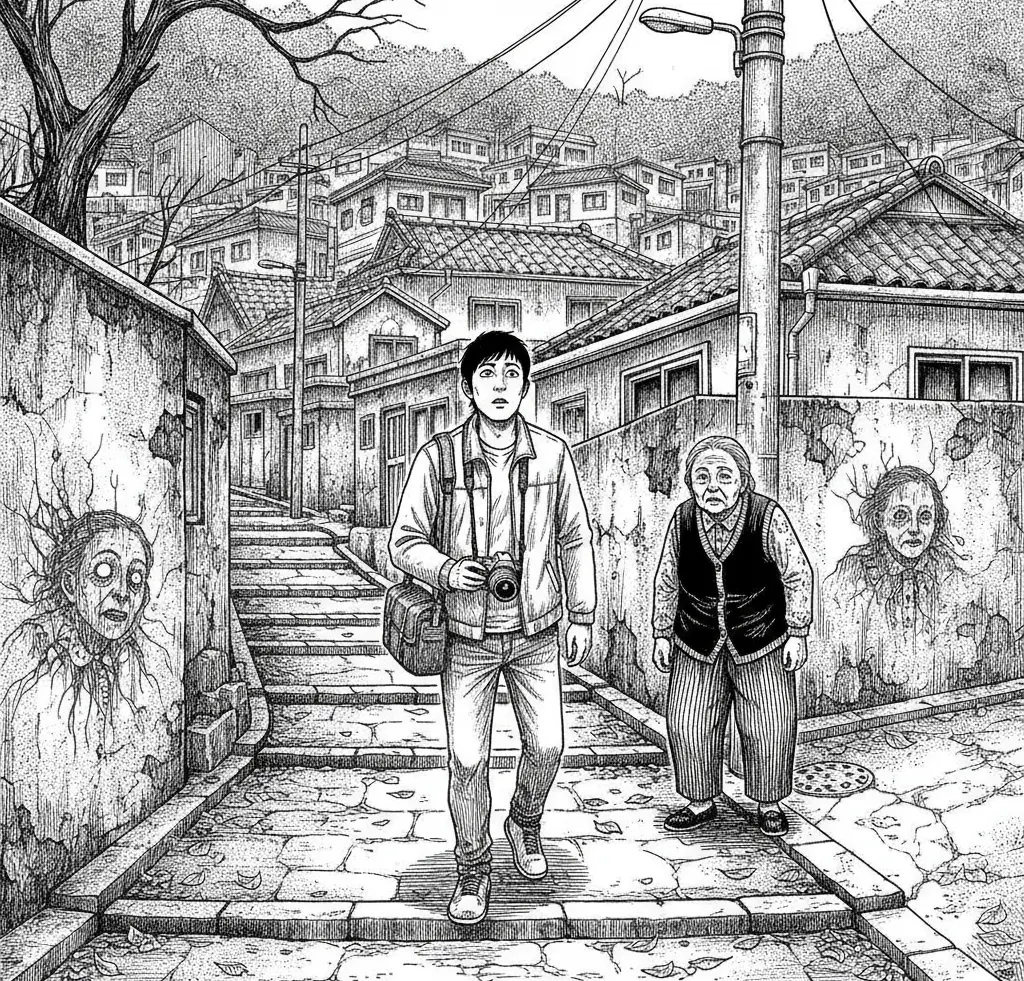
Lee Minjun arrived at Gamcheon Culture Village on a weekday morning in late autumn. Stepping off the bus at the Saha-gu stop and climbing the sloping road, he felt almost immediately that he had wandered somewhere he shouldn't have — but he let the feeling pass, chalking it up to the ordinary strangeness of an unfamiliar neighborhood. He had been working as a photographer for over a decade, had roamed alleyways and villages across the country, and to him the unfamiliar had always been something to welcome rather than resist.
The sky was overcast. A sea wind particular to Busan worked its way through the folds of his jacket, and above the narrow entrance stairs the pastel-colored rooftops stacked themselves in tiers. Being off-season, there were almost no tourists. Now and then an elderly woman descended the steps with a plastic bag in hand, or a cat's cry drifted up from somewhere deeper in the maze of lanes. Minjun adjusted the strap of his camera bag and walked further into the village.
Gamcheon was a singular place. It had begun, so the story went, when wartime refugees fleeing the Korean War built their homes shoulder to shoulder against the mountain slope. Over the decades that followed, murals were painted and sculptures installed, and the village was remade into a tourist destination — yet deep within it, houses where people actually lived were still packed tightly together, unchanged. That was precisely what Minjun was after. Not the pretty photographs that ended up in travel brochures, but the texture of a living alley. It was why he had chosen a weekday and come down alone.
He consulted the village map loosely and found his bearings. The further he turned off the main walking paths and into the interior lanes, the lower the rooflines dropped and the narrower the passages became. Faded murals clung to the walls; some had lost so much color that their subjects were nearly impossible to make out. Minjun walked and shot. The poor light forced him to push the ISO higher, and the higher he pushed it, the heavier and more dense the shadows in his photographs became.
After about an hour of walking, he stopped before an alley he had never seen. It wasn't on the map. It was barely wide enough for two people to pass each other, and the walls on either side rose so high that the strip of sky above was reduced to a thread. A flight of steps led into the alley's interior, and at the top stood a single iron gate painted pale blue, closed. There was nothing obviously wrong with it. And yet Minjun found that his feet would not move forward of their own accord. A current of air moved out of the alley toward him — not a gust, but a steady, low pressure, as though something were pushing gently at his back.
He ignored it and climbed the steps. From beyond the iron gate came a faint sound. At first he thought it might be a radio — the familiar noise of an occupied house bleeding through the walls. But the longer he listened, the more it seemed like a human voice, and then the less it seemed like one. It had no rhythm, so it wasn't a song; it didn't break or pause the way conversation does. It was simply a low, continuous sound, uninterrupted.
Minjun raised his camera and photographed the gate. Then he turned back. Strangely, the alley seemed far longer going down than it had coming up. He was certain ten steps would have been more than enough, yet no matter how many steps he took, the opening at the end drew no closer. He stopped and looked behind him. The iron gate was gone. He looked ahead. The end of the alley was gone too. Only the walls remained, pressing in on either side.
His heart struck once, hard. He breathed slowly and deliberately, and walked forward. Three steps, five steps. Then, without warning, the alley ended and the main walking path opened up before him. Minjun stood there a moment, looking back the way he had come. The narrow alley was right there. It was as short as he remembered. He let out a small laugh and wiped his forehead. He told himself his sense of direction had simply faltered in an unfamiliar lane on a gray day.

That evening he checked into a small guesthouse at the foot of the village. The owner was a woman who looked to be in her seventies; when he mentioned he was a photographer, she brought out warm barley tea and fell into easy conversation. As Minjun described the alleyways he had explored that day, he mentioned the lane with the pale blue iron gate — the one that didn't appear on any map.
The woman's hand paused. Only for an instant. Then she resumed pouring the tea as naturally as before. "Ah, that place," she said. "No one's lived there for a long time. They all moved away, years ago." When Minjun told her he had heard a sound from beyond the gate, she nodded. "The wind can sound like that. The alley's so narrow." Then she rose from her seat and added, almost as an afterthought: "It would be better if you didn't go back to that lane." Before he could ask why, she had already disappeared into the kitchen.
That night Minjun reviewed his photographs on his laptop. He had taken over three hundred shots throughout the day. He went through them one by one, selecting the ones worth keeping — alleyways, walls, staircases, faded murals. Then he reached the photograph of the pale blue iron gate.
At first nothing seemed wrong. The gate, the steps, the walls on either side. But as Minjun zoomed in, he stopped. On the wall beside the gate there was a mural. He hadn't noticed it when he took the shot. The paint had faded so completely that it was barely distinguishable from the wall itself. It depicted a group of people gathered close together. They were all facing the same direction. The direction they faced was precisely that of the camera lens.
Minjun enlarged the image further. The faces of the figures were blurred, as though worn away. But one of them — the figure standing farthest to the right — had an outline slightly more defined than the rest. And it was not standing. It was kneeling. Kneeling with its knees on the ground and its hands pressed together. And unlike the others, its face was not turned toward the lens. It was tilted upward. Looking above the frame, as though watching something beyond the lens itself.
Minjun closed the laptop. Then he opened it again. The photograph was unchanged.
He slept almost not at all that night. The following morning he decided to go back to the alley. Whether it was the professional instinct of a photographer or something else entirely, he couldn't say — but his feet carried him in that direction. The deeper he moved into the village, the thicker the fog became. He had heard that morning fog in Busan could be heavy, but not like this. Everything more than five meters ahead dissolved into gray.

Finding the alley with the pale blue gate took longer than expected. Yesterday he had stumbled into it by chance; today, no matter how many turns he made, it refused to appear. He circled the interior of the village three times. He was on the verge of giving up when an unfamiliar old woman appeared in front of him. She was bent nearly double, wearing a worn navy vest. Without a word, she raised one finger and pointed toward the interior of a lane.
Minjun followed the direction she indicated. He found the alley. When he turned back, the woman was already gone — vanished without a trace. He stood at the foot of the steps. Unlike the day before, the iron gate was open.
Beyond the open gate lay a narrow courtyard, surrounded by houses. The houses all appeared to be empty. Paper was pasted over the windows; doors were sealed shut with nails. In the center of the courtyard stood an old wooden bench, and on it something had been placed. Minjun walked closer.
It was a photograph. A single black-and-white photograph, its edges curled as though it had slipped from someone's home. He picked it up. It showed a village alleyway — which one, he couldn't tell. At the far end of the alley, a figure stood with its back to the camera. A person carrying a camera bag, holding a camera in one hand. Minjun stared for a long time at the figure's back, at the clothes it wore — the same clothes he had put on that morning.
He had not been the one taking photographs. Someone had taken a photograph of him. This morning, before he had even entered the village.
At that moment the iron gate swung shut behind him, pushed by the wind. Without a sound. Minjun turned. He walked to the closed gate and took hold of the handle. It wasn't locked. The door opened easily. He descended the steps and walked out of the alley.
He did not look back once on his way out of the village. Standing at the bus stop, waiting, his hands trembled slightly. The bus came and he boarded. Through the window, Gamcheon Village receded — its pastel rooftops stacked in tiers within the fog. It was beautiful. That, somehow, was the most unsettling thing of all.
While waiting for the train to Seoul at Busan Station, Minjun took out his camera and reviewed the photographs from that morning. The wooden bench in the courtyard, the sealed windows, the nail-shut doors. And the black-and-white photograph lying on the bench. A photograph of a photograph. He zoomed in and studied it. The figure standing at the end of the alley was sharp and clear — the hand holding the camera, the strap of the bag, the heel of one shoe.
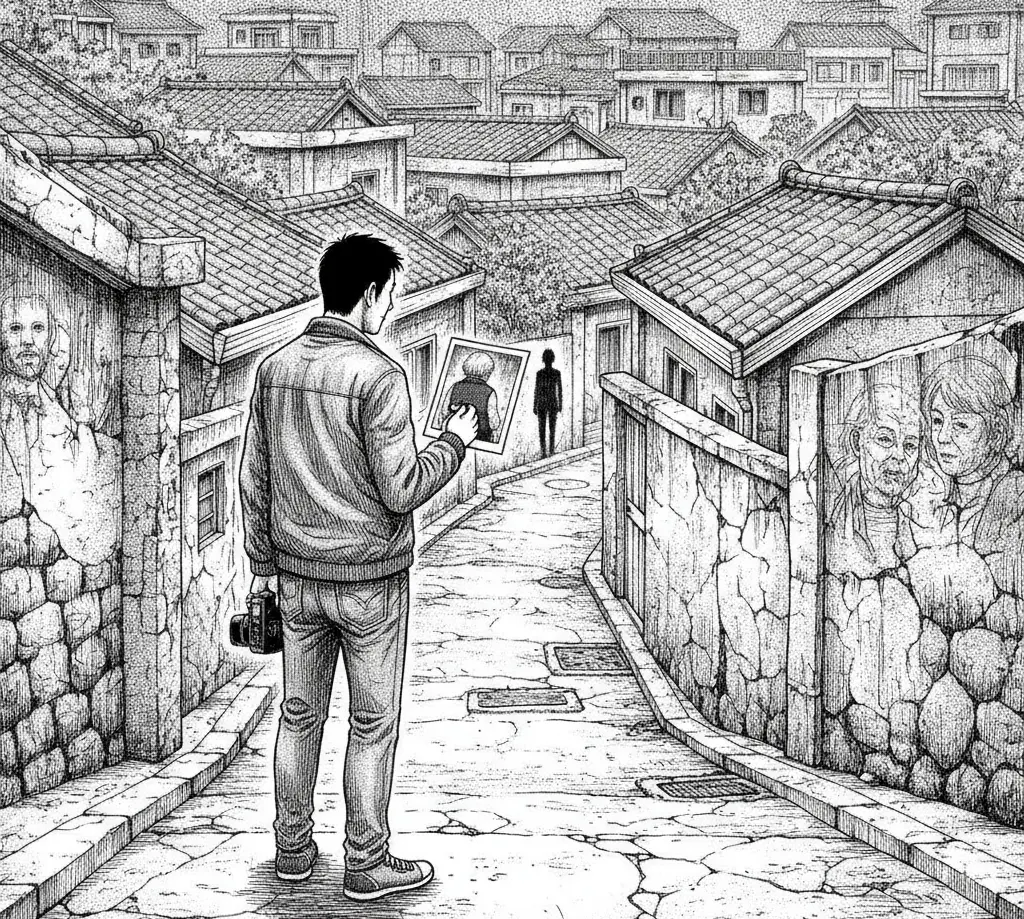
But there was something Minjun had not noticed at first, something he saw only now. Beside the figure's back, on the wall, there was a second shadow. It stood alongside the figure's own. Yet the person who should have cast it was nowhere in the photograph. The alley was empty. One figure seen from behind, and one shadow with no one to own it.
The train departed. Minjun pressed his forehead to the window and closed his eyes. Sleep seemed unlikely, but closing his eyes was the only thing left to do. In the darkness he heard the guesthouse owner's words again. It would be better if you didn't go back to that lane. He had never asked why. And now, he thought, he no longer wanted to know.
Then something else surfaced. When he had lifted the black-and-white photograph from the bench, there had been something beneath it. Hidden under the photograph, invisible until he raised it — and then visible, but only for a moment, because he had been too startled to look properly before he left. Something that had been lying on the bench, underneath the first photograph. It was another photograph.
Minjun opened his eyes and stared at the ceiling. The train entered a tunnel and the window went instantly black. He tried to remember what had been in the second photograph. He could not. He wasn't even certain whether he had simply left it there, or whether he had picked it up and set it back down. The absence of memory was itself strange. He reached back through his recollections, but that moment was formless and opaque, like something seen through fog.
The tunnel ended and the window brightened again. Minjun checked his camera bag. Camera, lenses, spare battery. Everything was there. But when his hand touched the outer pocket of the bag, he felt something inside it. He unzipped it. A photograph, folded in half, was tucked within.
He unfolded it slowly. Black and white. It was a photograph taken inside a train. A person sitting by the window, forehead resting against the glass, eyes closed. The posture was exactly the one Minjun had been holding until moments ago. And in the seat beside him — the seat that was now empty — someone was sitting. The face was not visible; the head was bowed. But that person's hand was resting on top of Minjun's hand.
Minjun looked down at his right hand.