

On the Bank of the Canal
AI AI-generated fiction — text, and any narration or images. Unrelated to any real events, people, organizations, or places.
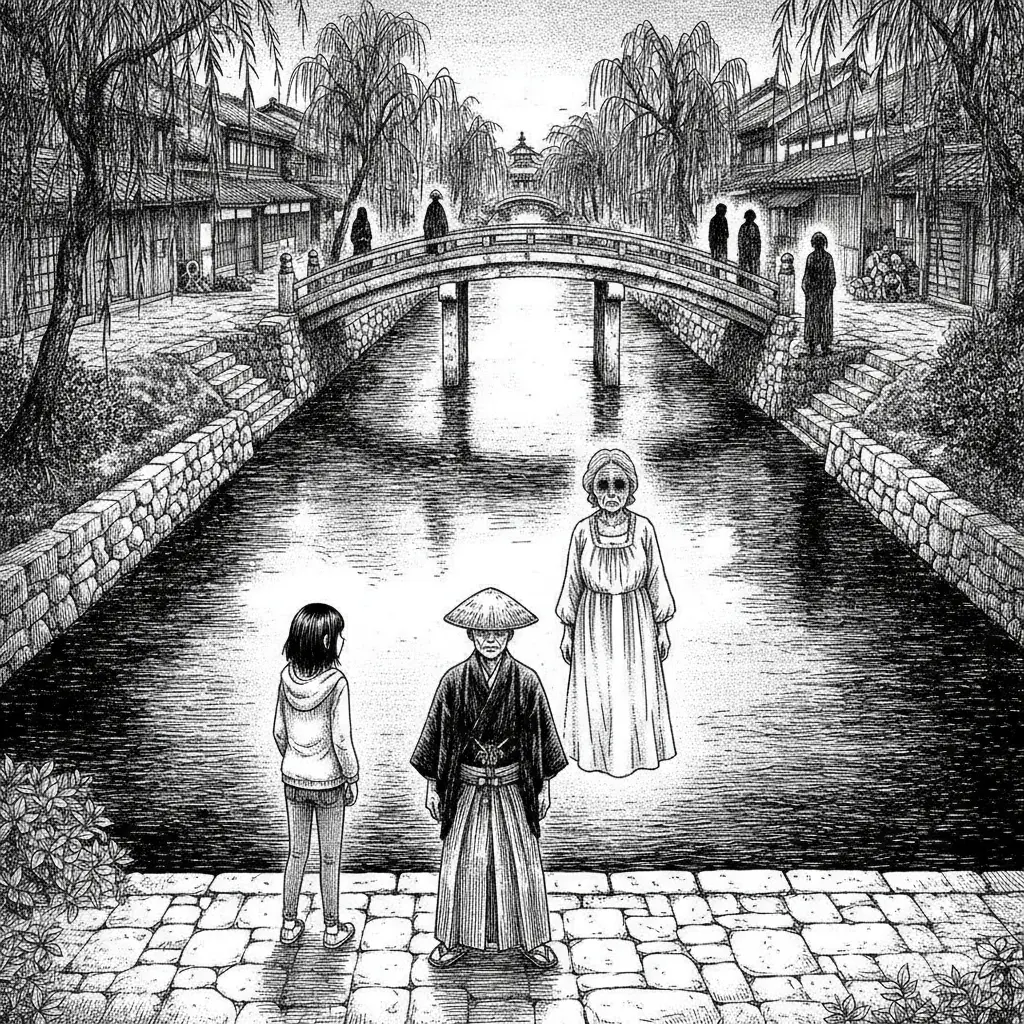
The canals of Yanagawa seemed to go on forever.
Tanaka Aoi (田中葵) came to Yanagawa at the end of September for her grandmother's forty-ninth-day memorial service. For Aoi, who worked at an advertising agency in Tokyo, this town was a place she had visited only a handful of times in childhood, and what remained in memory was vague — the smell of green things, the creak of a wooden boat. Her grandmother's house was an old single-story home near the canal, a little outside the town center, where the relatives were to gather and hold the service. Aoi had arranged to arrive a day early, and she rode the Shinkansen alone, transferred at Hakata, and swayed along on the Nishitetsu line, watching the landscape of the Chikugo Plain drift past the window. Rice stalks heavy with grain caught the evening light and turned gold, and beyond them the low ridge of distant hills floated faintly against the sky. She had the feeling of arriving somewhere where time moved differently.
When she stepped off the train at Yanagawa Station, the air was entirely changed. The humid dusk wind brushed her cheek, and from somewhere came the presence of water. The information board at the station entrance bore the words "Water Town Yanagawa" with a kind of civic pride, and beneath them a map of the canals — a grid of waterways that made the whole town look as though it floated on the surface of a lake. Aoi pulled her rolling suitcase along the road toward her grandmother's house. Once she moved a little away from the center of town, the bustle of the tourist boat landings faded, and there was only a narrow path running alongside the canal. Willow trees stood at the edge of the stone-paved road, their branches hanging long toward the water. Aoi checked the map on her phone as she walked, but the signal was poor and the screen kept failing to update.
At her grandmother's house, the key was in the mailbox. A message from her uncle, Kuroda Shinichi (黒田信一), who was coordinating the memorial arrangements, said: "I'll arrive tomorrow morning. You'll be alone tonight, but I've left the key — please stay." Aoi let herself in, turned on the lights, and set down her bags. Two eight-mat tatami rooms opened into each other, with a kitchen and bathroom beyond the corridor — the layout of a typical Showa-era farmhouse. The house held the smell of her grandmother's long years there: incense, old tatami, and something else she couldn't quite name. As Aoi unpacked, she looked around the room. On the altar stood her grandmother's portrait, chrysanthemums arranged before the unlit candles. Her grandmother had been a small woman, always smiling. But the last time Aoi had seen her, three years ago, her grandmother had already struggled to recognize her.
Aoi ate a convenience store dinner, bathed, and then stepped out onto the engawa. Beyond the narrow veranda, the canal was right there — the night water reflecting the streetlights in a dull, flat gleam. The surface did not move. It looked like black glass. The willow branches swayed faintly, though there was no wind. Aoi sat for a while and smoked a cigarette. It was a stillness she never felt in Tokyo. No car sounds, no voices. A few lit windows showed in the houses on the far bank, but beyond those, only darkness.
It was then that she first noticed the figure on the opposite shore.
Directly across the canal from where she sat — right across from the engawa — there was a low stone bridge with a railing. At the end of that bridge, someone was standing. In the darkness she could only make out a silhouette. She could tell it was the shape of a person, but it did not move. It simply stood. Aoi held her cigarette and looked at the shadow. She did not feel frightened, not exactly. She told herself it was someone out for a walk who had stopped. But as she kept looking, something nagged at her. The figure was facing her way. Facing her, without moving at all. She glanced away and looked back. It was still there. Aoi pressed her cigarette into the ashtray, stepped back inside from the engawa, and slid the shoji closed. Nothing to worry about, she told herself.
The next morning, her uncle Kuroda arrived by car. The service was in the afternoon, and until then Aoi helped him sort through a few things in the house. Kuroda was a quiet but kind man in his early sixties who had always looked out for her. Over lunch, Aoi mentioned the previous night — how someone had been standing on the bridge across the canal, facing her way, not moving. Kuroda was silent for a moment, then said, "Ah."
"That bridge," he said. "There have always been stories about it. Several people around here have said they saw someone standing at the end of that bridge."
"I think it was a real person," Aoi said.
"Maybe so," Kuroda answered, and said nothing more.
The memorial service passed quietly. A priest chanted sutras, the relatives offered incense, and they pressed their hands together before the portrait. Aoi cried more than she had expected to. She had a morning train the following day, so she would spend one more night in her grandmother's house. The other relatives, including Kuroda, all left that same evening, and Aoi was alone again.
Night came.
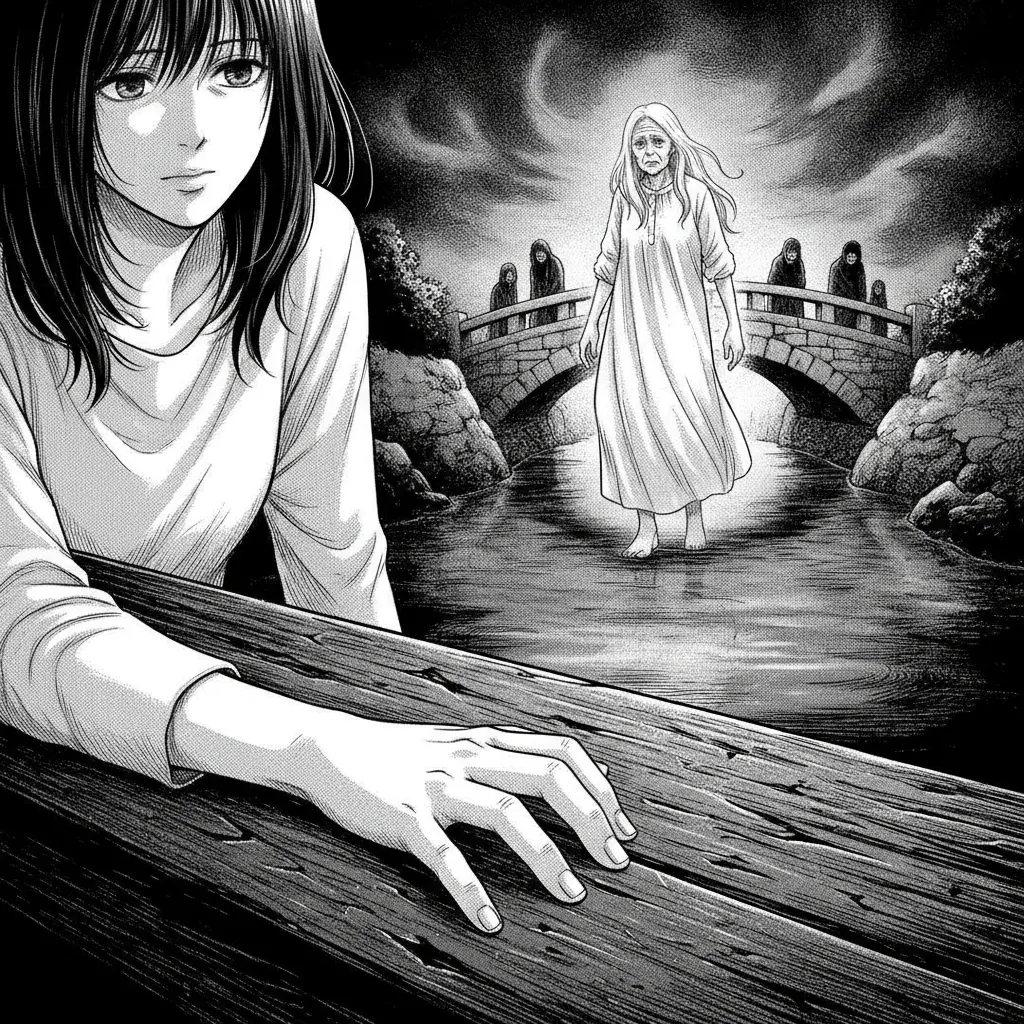
Aoi sat before the altar for a while, looking at her grandmother's portrait. During the service, she had heard from the relatives that her grandmother had spent the last few years living almost entirely alone in this house. Her dementia had worsened; neighbors had looked in on her, but she had been found wandering near the canal on several occasions. Sometimes, in the middle of the night, she had been found sitting on the engawa, staring at the far bank. Hearing this, Aoi laid it over her memory of the previous night's engawa. The thought that her grandmother had also gazed out at that canal caught somewhere in her chest and would not let go.
That night, as Aoi was drifting toward sleep, she heard a sound.
It was not the sound of water. It was closer than that. From somewhere inside the house came a faint sound — something moving, or being dragged. Aoi lay in her futon with her eyes open, listening. It seemed to be coming from the direction of the kitchen. It could have been a mouse, or the old house settling. But the sound continued. Rhythmic, at even intervals. She got up, turned on her phone's flashlight, and went out into the corridor. She walked toward the kitchen and flipped the light switch.
There was nothing in the kitchen.
The tap at the sink was dripping, just barely. The drops falling into the basin — that was the sound. Aoi tightened the tap and turned back down the corridor. As she passed the altar room, she glanced inside.
A candle was burning.
She was certain she had extinguished the candles after the service. They had all checked together before the relatives left. Yet now the candle burned quietly, its flame perfectly still, perfectly upright. Aoi went in and blew it out. She looked at her grandmother's portrait. Her grandmother was smiling. Aoi said softly, to the photograph: "Grandma, candles are dangerous." Then she was mildly startled by her own words — she had spoken as though her grandmother had only just stepped away from the room.
As Aoi stepped back into the corridor to return to her futon, a shadow fell across the shoji of the engawa.
It was unmistakably human. The outline of a head, shoulders, hands hanging at the sides. Someone was standing just beyond the paper screen. Aoi's body went rigid. She could not make a sound. She held her breath and stared at the shadow. It did not move. It simply stood there — just as the figure on the bridge had stood the night before. Aoi backed away slowly, retreated to the kitchen, and reached for the drawer where the knives were kept. But in that moment, a sound came from the direction of the corridor. The shoji of the engawa slid open — without a sound, and yet she heard it open.
Aoi looked out from the kitchen into the corridor.
The shoji was open. Someone was sitting on the engawa.
A small old woman sat on the edge of the veranda, looking out at the canal. Her back was to Aoi. She wore something white, like a sleeping robe, and white hair spread across her back. She did not move. She only looked toward the water. Aoi tried to say "Who are you?" but the words stuck in her throat. The old woman's white hair moved slowly, though there was no wind. Aoi finally managed: "Who are you?" Her voice was shaking.
The old woman turned, slowly.
It was her grandmother's face.
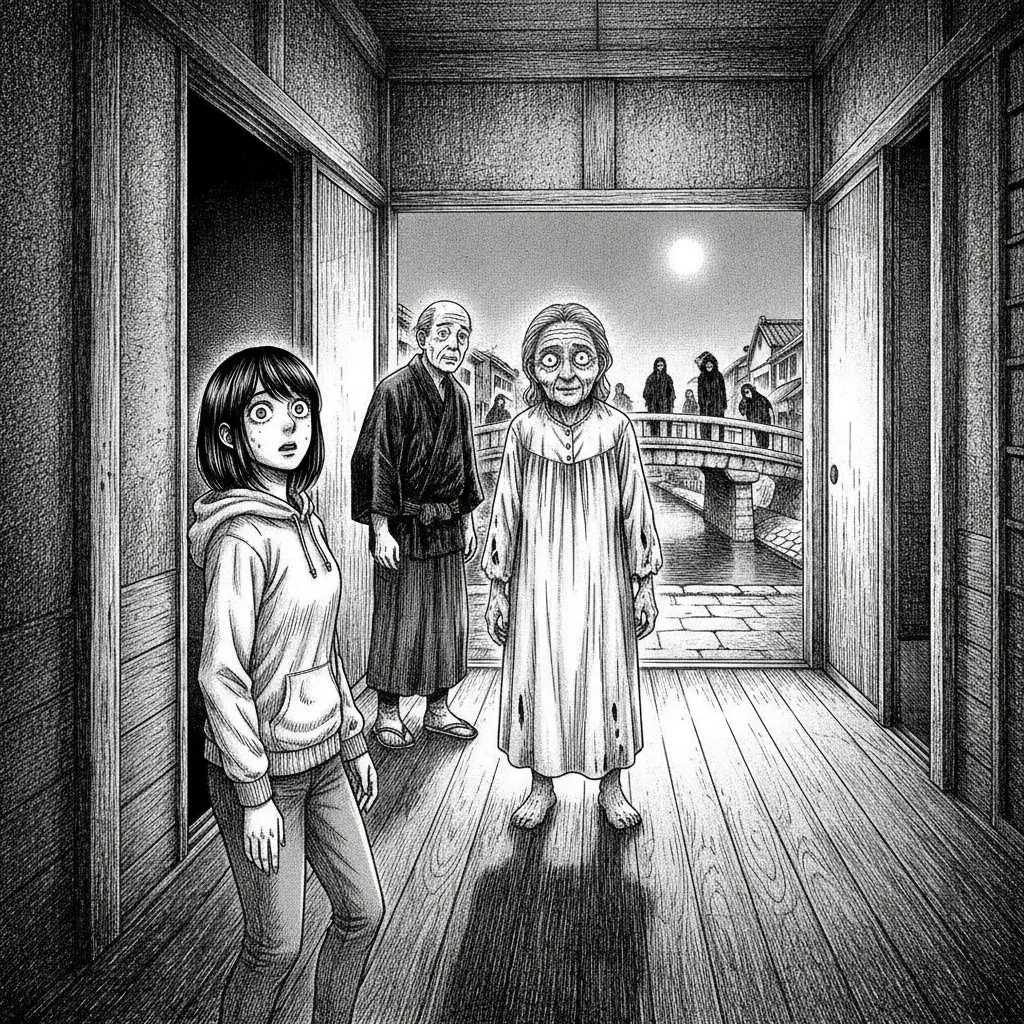
Aoi froze in the corridor. Her grandmother's face, exactly as she remembered it — the deep lines, the narrow eyes, the familiar smile. But the smile was slightly wrong. The corners of the mouth were pulled just a little lower than in her memory. The eyes were open just a little too wide. "Grandma," Aoi said. The word came out, but she could not feel it as her own. The old woman said nothing. She only looked at Aoi. Then, slowly, she turned her face back toward the canal.
Before Aoi understood what she was doing, she had moved closer to the engawa.
She stood beside the old woman and looked out at the canal. The night water was black and still. The streetlight lay in a long thin reflection on the surface. Aoi looked at the old woman's profile. It was her grandmother's face, she was certain. And yet something was wrong. There was a feeling of something beneath the skin. "Grandma," Aoi said, "you've already died, haven't you?" The old woman did not answer. She only looked at the canal.
Then Aoi saw it.
Where the old woman's gaze was directed, there was the bridge. Last night's bridge. And on that bridge, tonight, there were figures. Not one. Two, three — more. Along the railing of the bridge, a row of figures stood side by side. Every one of them was facing this way. Every one of them was still. Aoi tried to count them, but in the darkness she could not manage it. Seven, eight — perhaps more.
The old woman opened her mouth.
"They're all waiting."
The voice was low and dry. It was not her grandmother's voice. Or perhaps it was, but not the voice Aoi had known. "Who is waiting?" Aoi asked. "Waiting for what?" The old woman did not answer. Instead, she stood. She moved to the edge of the engawa and took one step toward the canal. Aoi grabbed her arm without thinking. The arm was there. Thin and cold and undeniably there. The old woman stopped. Aoi held the arm and looked at the figures on the bridge.
They were moving.
They had left the railing and were walking slowly in this direction — crossing the narrow bridge over the canal, moving along the stone-paved path, in a single file. Aoi tried to step back but could not move well while holding the old woman's arm. The old woman did not resist. She only stood there, watching the figures come. Aoi released the arm and threw herself back inside through the shoji, sliding it shut behind her. There was no lock. She ran to the altar room and searched for her phone. She tried to call her uncle. The call connected. It rang. No answer. She ran to the kitchen and tried the back door. She pulled it open.
Someone was standing outside.
In the light of the streetlamp, she could see the face. An old man. A face she did not know. White-haired, short, dressed in white. Beside him stood another person — the same quiet stillness, the same white clothing. Aoi shut the door and locked it. She felt her hands trembling as she turned the key. She sank to the kitchen floor. Her mind was in pieces. Beyond the window, she sensed a presence — the soft sound of footsteps, as though several people were walking around the outside of the house. But there was no knocking. No voices. Only the sound.
She did not know when it stopped.
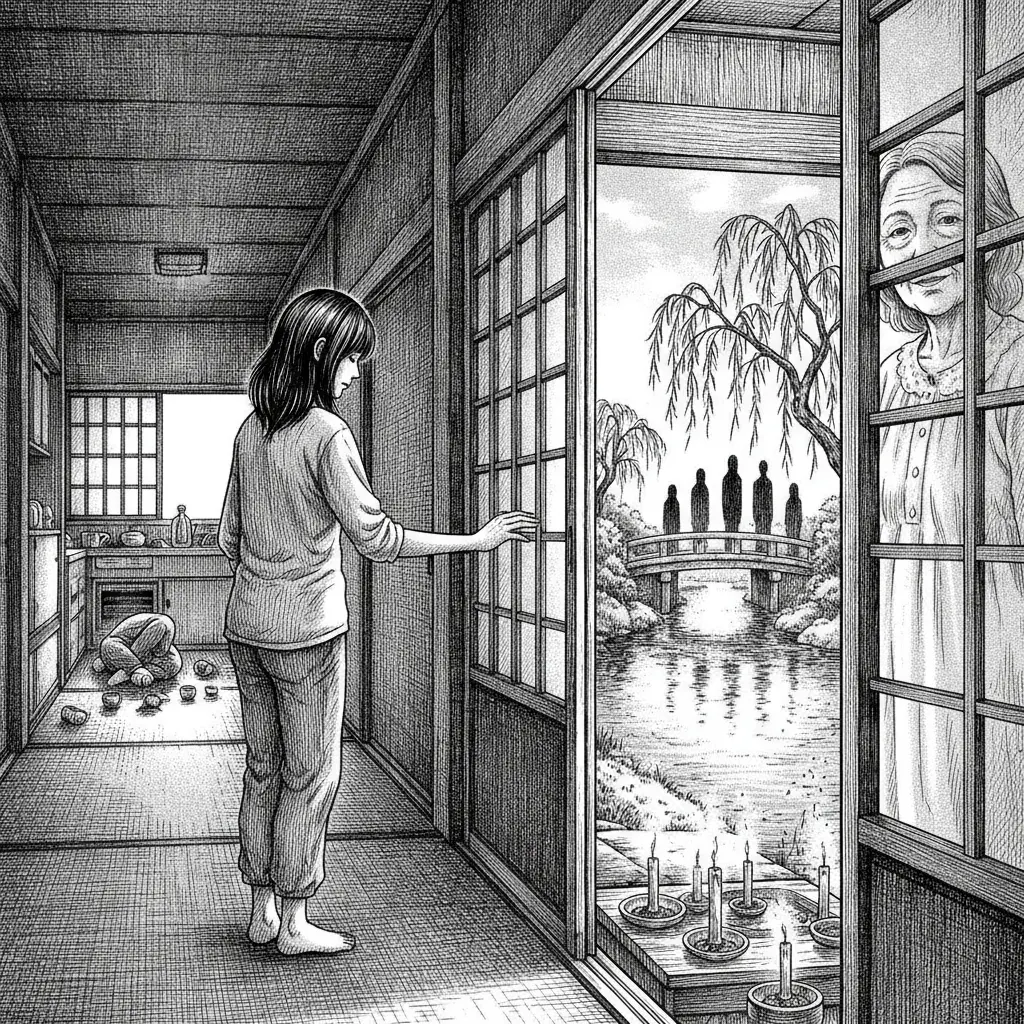
When she became aware again, it was dawn. She had fallen asleep sitting on the kitchen floor. Morning light came through the window. She stood, went out into the corridor. The shoji of the engawa was closed. In the altar room, the candle was out. Her grandmother's portrait looked at her with its usual smile. Aoi gently slid open the shoji. The morning canal was calm, the surface catching the early sun and scattering it in small bright pieces. The willow branches swayed. The bridge was empty.
Aoi left Yanagawa on the morning train. She tried to tell her uncle what had happened the night before when she called him, but the words would not come. She tried to tell herself it had been a dream. But the fact of having slept on the kitchen floor refused that explanation. "Did something happen?" her uncle asked from the other end of the line. "No," Aoi said. "Nothing happened." She could not find any other way to say it.
From the window of the Nishitetsu train, Aoi watched Yanagawa recede. She could see the canals — the grid of waterways dividing the town, shining in the morning light. At the edge of one canal, there was a bridge. A small stone bridge. Aoi narrowed her eyes.
Someone was standing on the bridge.
The train picked up speed and the scene swept away. Aoi turned from the window. She leaned back into her seat and closed her eyes. Her heart was beating a little too fast. When she got back to Tokyo there would be work, and friends, and ordinary life. She tried to hold onto that. But behind her closed eyelids, the face rose up again. Something wearing her grandmother's face, sitting with its gaze turned toward the canal. Saying: "They're all waiting."
Waiting, it had said.
For whom.
Aoi opened her eyes. Outside the window, the Chikugo Plain spread wide. Harvested fields ran on and on. Low mountains in the distance. A gentle autumn landscape, unremarkable in every way. Aoi looked at it, and something came to her.
Last night, when she had grabbed the arm of the old woman sitting on the engawa, the sensation of that arm was still with her. Thin, and cold. That much she had known then. But now she remembered something else. When her fingers had touched the wrist of that arm, she had felt something — or rather, had not felt something. She had not been trying to check, but she had checked all the same, because her fingers had been there. There was no pulse.
The train accelerated. Yanagawa was gone from sight.
Aoi looked at her left hand — the hand that had held the old woman's arm. On the palm, something faint remained. The smell of the canal, if that was the right word for it: damp earth and grass and decomposing leaves, all mixed together, still clinging to her skin. Aoi closed her hand into a fist and set it on her knee.
Outside the window, she thought she saw someone wave.
She did not look to confirm it.