

Next to Osorezan
AI AI-generated fiction — text, and any narration or images. Unrelated to any real events, people, organizations, or places.
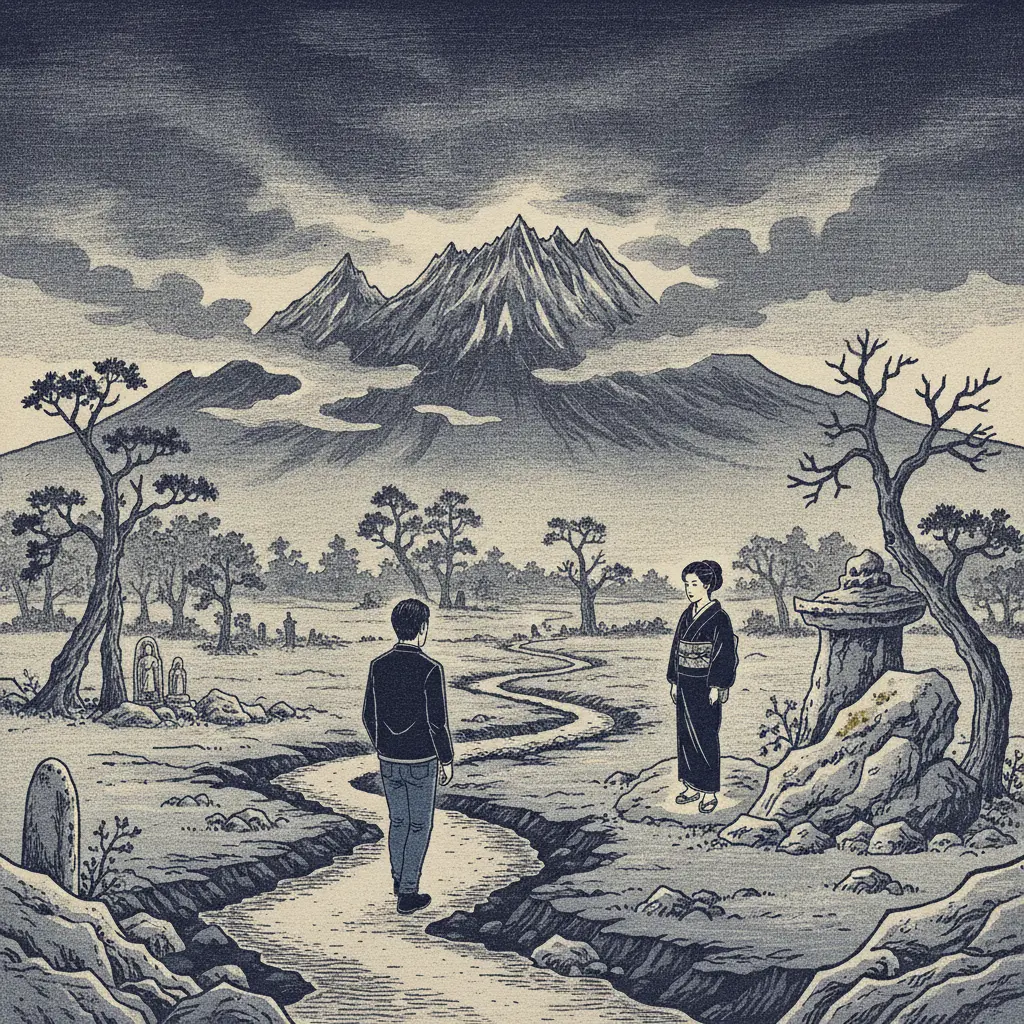
At the end of August, Miyata Seiichi traveled alone to the foot of Osorezan.
Three years had passed since his wife Yayoi died. By the time the tumor was found it was already too late, and she slipped away quietly seven months after the diagnosis. Afterward, Seiichi went through his days in a narrow Tokyo apartment as though living inside a hollow. He managed to keep working, but every time he came home he dreaded turning on the entryway light. Because once it came on, he would have to confirm all over again that Yayoi was not there.
There was no particular reason he decided to go to Osorezan. A colleague had said, half-mockingly, that if you asked an itako at Osorezan you could hear the voice of someone who had died — and for some reason those words lodged in a corner of his mind and refused to leave. Seiichi was not a religious man. But one night he realized he could no longer recall Yayoi's voice even in his dreams, and a sharp panic seized him. He remembered her face. The way she laughed. But her voice alone was slipping away, sliding through his fingers like sand, gone before he could catch it.
He took a bus from Aomori Station to Mutsu City. He planned to spend one night at a small inn in town and set out early the next morning for Lake Usoriyama. The innkeeper was a taciturn woman of about sixty, and when Seiichi told her he was going to Osorezan, she gave a single small nod and said nothing more. The silence felt strangely heavy.
The night in Mutsu City was quiet. There were few streetlights, and the darkness pooled thickly at the edges of the road. After dinner Seiichi walked a little near the inn. There was one convenience store, its light falling pale and flat on everything around it. Yayoi had loved to travel, but they had never come to the Tohoku region together. They had talked about going, but it never came to pass. Seiichi stood in front of the convenience store and stared through the glass at the fluorescent light, asking himself once more why he had come. No answer came. And yet coming here was the only thing he had been able to think to do.
The next morning the fog was thick. The outlines of the mountains visible through the bus window dissolved softly into white. Partway along the road to Osorezan the smell of sulfur began, and as it grew stronger an unnameable tension accumulated in Seiichi's stomach. Sulfur has a particular quality — it resembles rotten eggs, yet carries a sharp mineral edge beneath it. It is the kind of smell the human nose instinctively reads as danger, Seiichi thought. And here it drifted without cease.
Passing through the main gate of Osorezan Bodaiji, he found the grounds quieter than he had expected. Perhaps because he had come just after the grand festival season, the number of visitors was sparse. He had seen photographs of the hundreds of pinwheels standing in rows, but seeing them in person brought a suffocating pressure he had not anticipated. Faded red and white and yellow pinwheels spinning all at once, each one. When he thought that every single one of them held someone's prayer for someone lost, Seiichi found he could not move from where he stood.
When he reached the shore of Lake Usoriyama, the sulfur smell grew denser still. The lake was clouded milky white, and along its banks stretched a desolate expanse of bare rock. Almost nothing grew there; the earth, stained brown, lay exposed. This was the place called Sai no Kawara — the Riverbed of the Underworld. The place where the spirits of children stack stones. The place where demons knock the stones down. Seiichi crouched beside one of the cairns and stared at the loosely piled pebbles. Stones that someone's hands had touched. Stones into which someone had pressed a prayer. He wondered for a moment whether Yayoi was somewhere stacking stones, then pushed the thought away. For some reason it simply did not seem like the kind of place she would be.
He looked for an itako, but there was none performing that day. When he asked someone at the temple, he was told that itako were not in residence outside the festival period. Seiichi felt a mild deflation, but also something like relief. He had not come to hear Yayoi's voice, he realized — he had simply needed to go somewhere. It was only now, having arrived, that he understood this.
In the afternoon Seiichi passed back through the main gate. He was heading toward a hot spring inn along the approach road, but he noticed a narrow path veering off to one side, the kind of track an animal might have worn, leading around to the far side of the lake. There was no sign forbidding entry. Someone had trodden it down; the grass parted to either side. Without quite deciding to, Seiichi began walking it. The sulfur smell thinned, replaced by the mingled scents of damp earth and dead leaves. Branches laced together overhead, and the August light came through in fragments.
After a while, he saw a figure.
At first he took it for a tree root or a fallen trunk. But the shape moved, slowly. It was a woman. She wore a black kimono and her hair was gathered behind her. She looked to be in her fifties or sixties, but her back was straight and her step unhesitating. When Seiichi called out to her, she turned. Her features were composed, but her face held almost no expression. Her eyes made it impossible to tell whether she was looking at him or through him.
"Have you lost your way?" she said. Her voice was low and dry.
Seiichi started to say he had not, then realized he was no longer entirely sure. "I'm just taking a walk," he said. The woman nodded and said, "Come with me." He could think of no reason to refuse.
She left the path and went deeper in. Small stones were scattered underfoot, and each step produced a dry, hollow sound. Through the trees the lake appeared — the milky surface catching the light in broken flashes between the leaves. The woman stopped and murmured something toward the water. Seiichi could not make it out.
"You are looking for someone," she said, without turning to face him.
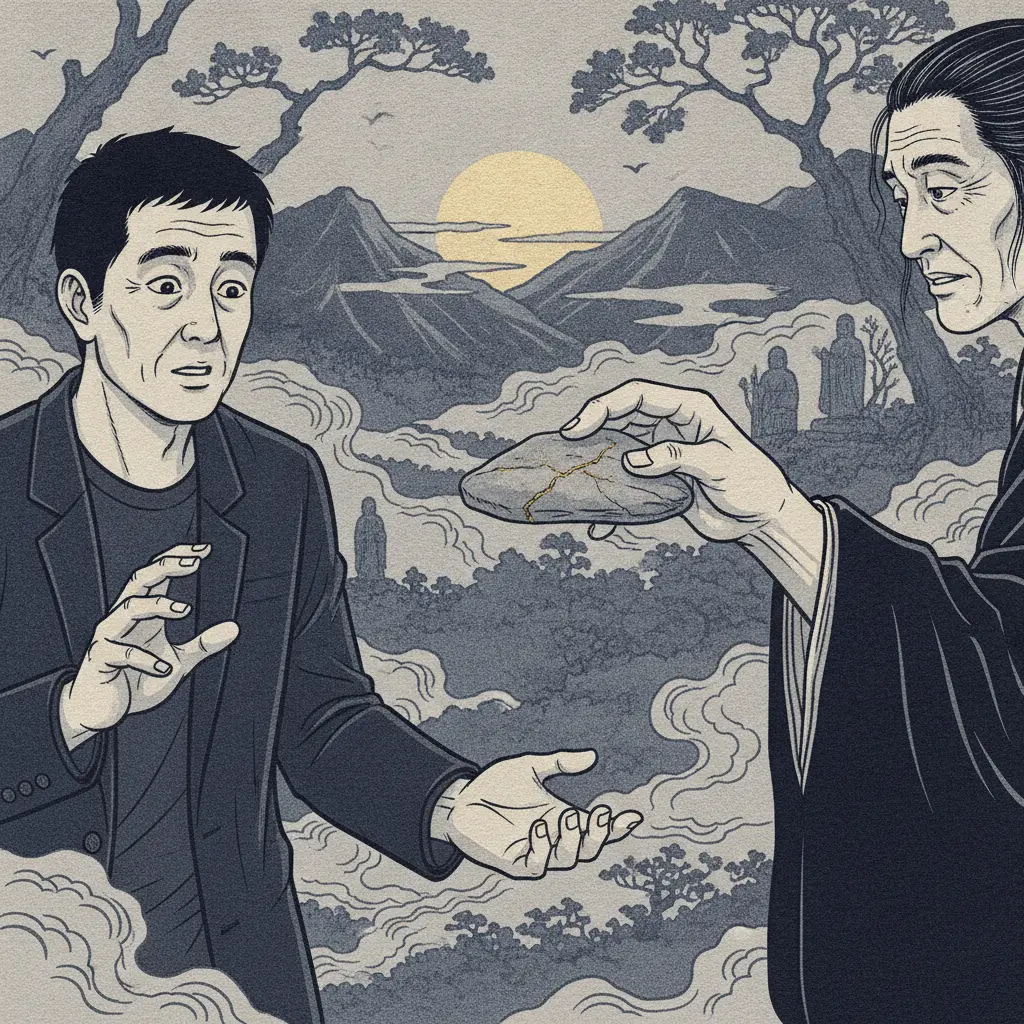
Seiichi was mildly surprised, but then thought that most people who came here had some such reason. "My wife died," he said. "Three years ago."
"Do you want to hear her voice?"
"Her voice — yes. I feel as though I've forgotten it."
The woman was silent for a time. Wind came off the lake and stirred the hem of her kimono. Then she turned slowly and looked at Seiichi directly. Her eyes, this time, held him clearly. Their color was strangely pale — a grayish brown, like the surface of a lake under an overcast sky.
"Did you hear anything?" she said.
Seiichi heard nothing. "No," he answered, and the woman tilted her head almost imperceptibly. "Wait a little longer," she said, and turned back toward the lake.
The wind stopped.
In that instant a strange sensation overtook Seiichi. The feeling that someone was standing behind him. He turned — no one was there. And yet he was certain he could sense something breathing at his back. The air was moving. Something the size of a person was right there, just behind him. With a tightening in his throat, he asked the woman, "What is there?"
The woman did not turn. "Someone who is calling to you," she said.
Seiichi could not move. The presence behind him did not fade. If anything, it seemed to be drawing closer, little by little. There were no footsteps. No smell. Only the sensation of the air changing density around him. He thought of Yayoi. How he wished it were Yayoi. But something deep in his body told him it was not. Yayoi's presence had never felt like this. Yayoi was always soft, always warm; when she stood beside him she kept a distance just close enough that their shoulders might brush.
Whatever was behind him was cold.
Seiichi steeled himself and turned around.
There was no one. But in the darkness between the trees he thought he glimpsed the outline of something — shaped like a person, yet slightly too tall. The part that corresponded to a head was tilted faintly to one side. Within a second or two it dissolved into the shadow of a tree trunk and was gone.
When Seiichi turned back, the woman was gone.
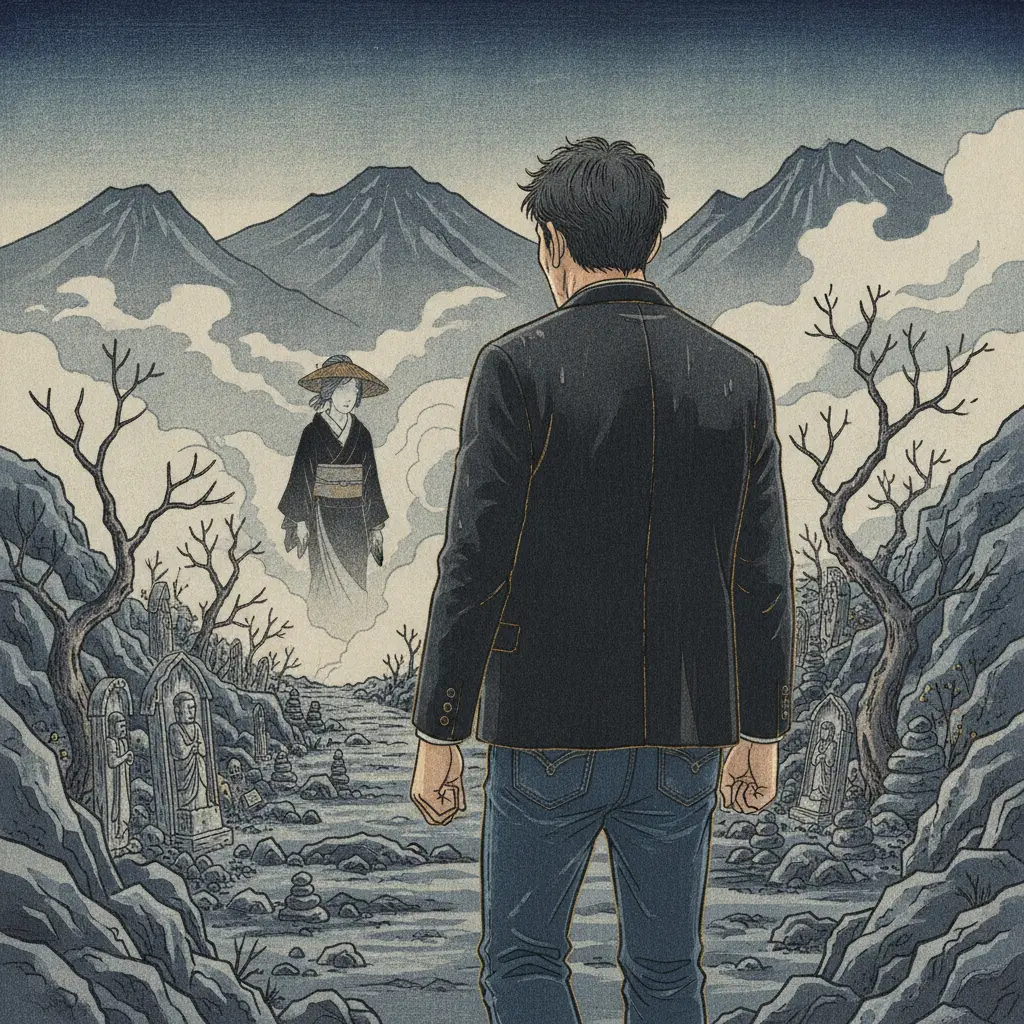
He had no idea where she had gone. All the way back along the path he did not look behind him once. If he looked back, he felt certain he would see it again. His heart was beating fast, but his feet kept moving at a steady pace. When he reached the approach road he noticed that his whole body was drenched in sweat. It was the end of August, but the air at Osorezan was cold. And yet he was sweating.
He returned to the inn, ate dinner, and took a bath. The sulfurous hot spring should have warmed him to the bone, but a single point on his back remained cold — between the shoulder blades, roughly. The place where it felt as though someone had pressed a palm. He rubbed the spot again and again in the water, but the coldness would not leave.
He woke in the middle of the night.
The room was dark and the inn was utterly still. Lying on his back staring at the ceiling, Seiichi became aware that he had been dreaming. He could remember almost nothing of it, but he had the sense that Yayoi had appeared. She had been saying something. But there was no sound. Her mouth was moving and nothing came out. And in the dream, someone had been standing behind Yayoi. Something taller than a person, its head tilted to one side.
Seiichi sat up and switched on the lamp by his pillow.
In the corner of the room stood the woman in the black kimono.
It was the same woman from the path that afternoon. Black kimono. Hair gathered back. A face without expression. She was standing near the entrance to the room, and she appeared to be looking at Seiichi — but not quite at Seiichi. Her gaze was directed slightly to his side, at the empty space beside him.
Seiichi could not speak. He could not move.
The woman opened her mouth slowly. "Can you hear?" she said.
Seiichi heard nothing. But the space toward which the woman's gaze was directed seemed, faintly, to waver. Not the air trembling — the space itself, as though separated by a thin membrane into a near side and a far side.
"I can't hear anything," Seiichi said. His voice came out hoarse.
The woman nodded. "But she is beside you," she said.
Seiichi looked at the space where the woman's eyes were resting. There was nothing. Only a dark wall and the inn's furnishings. But that nothingness felt, tonight, as though it had a slightly different texture than usual. He thought he caught the scent of something Yayoi had loved — just for an instant. The smell of cherry blossom soap. Then the sulfur smell covered it over and it was gone.
The woman said something else. This time Seiichi could not hear it. She was not speaking to him — she was speaking to the space beside him. She continued for a while, addressing that space, and then she looked at Seiichi.
"Did you hear her voice?" she asked.
"I didn't."
"I see," the woman said, and said nothing more.
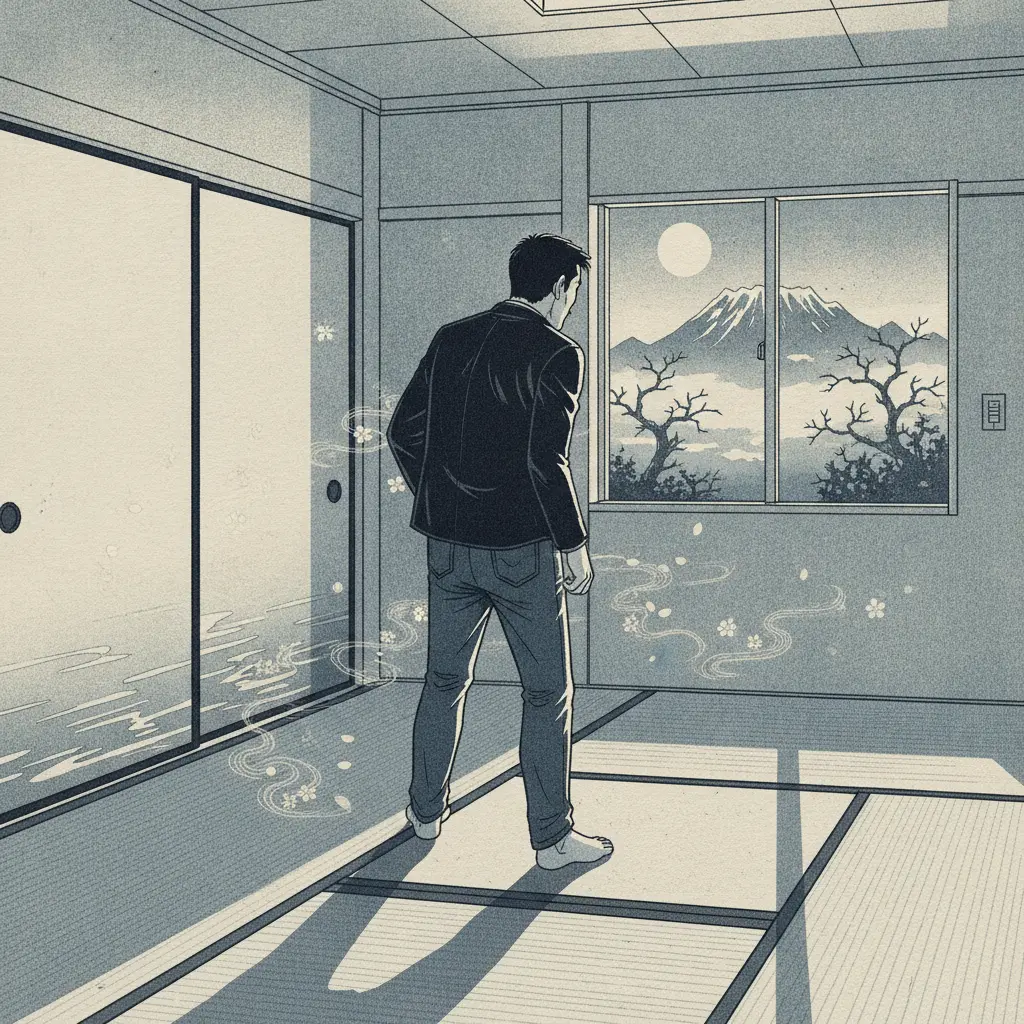
When Seiichi blinked, the woman was gone. The door to the room was still closed. The window was still closed. Only the air in the room seemed subtly changed. The sulfur smell had thinned, and in its place there lingered something like the ghost of a sweetness. Perhaps it was his imagination. But Seiichi did not sleep again that night.
By morning the fog had grown even thicker.
Seiichi packed his things and left the inn. He had time before the return bus, so he went and stood once more before the main gate. There were even fewer visitors than the day before, and the grounds were nearly empty. The pinwheels were spinning. Faded prayers turning quietly against the sky.
There, Seiichi mentioned the woman to the innkeeper. A woman in a black kimono, with no expression on her face. He had met her on the mountain path and she had appeared in his room during the night. The innkeeper paused before answering. "I wonder who that could be," he said. "There are stories of a woman in a black kimono in these parts, but whether she is among the living — that I cannot say." The answer lodged in Seiichi and went on snagging at him long afterward.
On the bus back to Mutsu City, Seiichi watched the mountain scenery flowing past the window. Shadows of trees surfaced from the fog and vanished. He still could not recall Yayoi's voice. But the panic he had felt at being unable to remember it had shifted, overnight, into something of a different temperature. The silence where her voice had been was not the same as her absence. He felt as though someone had told him this. He did not know who.
A week after returning to Tokyo, Seiichi pulled out an old photo album. There were many photographs of Yayoi. Photos from the year they married. Photos from trips they had taken. Photos from before she became ill, photos of her laughing. He went through them slowly, one by one.
Then his eye stopped on one of Yayoi laughing.
It was a photograph he had no memory of. The background was a mountain, and there was fog. Yayoi was turned toward Seiichi, smiling. But at the edge of the photograph, just slightly behind Yayoi, a small figure in a black kimono was visible. The expression was impossible to make out. But the way the figure stood — Seiichi was certain it was the same woman.
The problem was that this photograph had been taken during a period when Seiichi and Yayoi had never once visited the Tohoku region.
The date printed on the photograph showed a summer two years before Yayoi died.
For a long while Seiichi sat staring at the photograph. Beyond the window Tokyo's night spread out, and the apartment's light fell evenly across the room. Yayoi's smile did not change. The dark figure in the fog did not change.
Seiichi did not close the album.
He could not bring himself to close it.