

The Face Beneath the Water
AI AI-generated fiction — text, and any narration or images. Unrelated to any real events, people, organizations, or places.
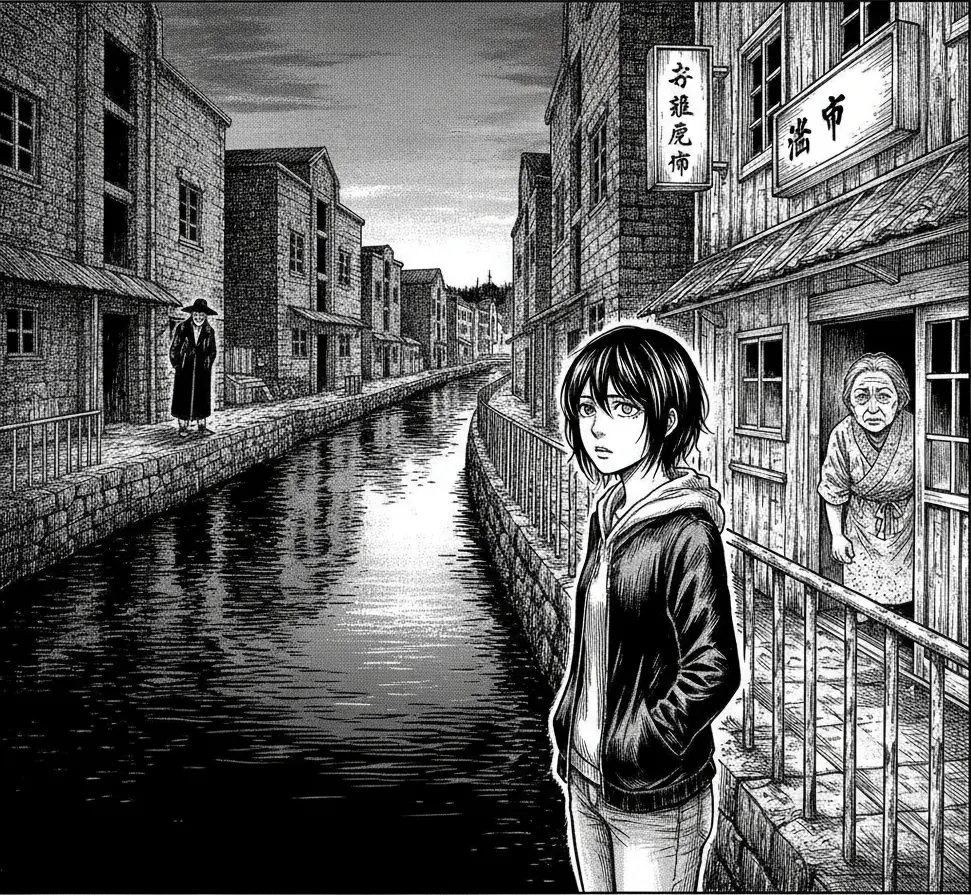
I took the cheap lodgings along the Otaru Canal at the end of October for no reason other than the price. It was a Monday, a weekday outside the tourist season, and the stone warehouses already wore the half-sleeping look of buildings that have given up expecting visitors. The surface of the canal reflected nothing.
My name is Nakamura Saku (中村朔). I am thirty-two, a freelance writer. I had come to Otaru to finish a piece for a Hokkaido feature. The editorial notes handed to me listed safe, predictable phrases — "the canal at night," "the history of the stone warehouses," "the mood of the gas lamps" — but the truth was I had been quietly looking forward to the trip. Less than an hour from the noise of Sapporo, the air of this worn port town was nothing like the suffocating air of Tokyo. I dropped my bags at the inn and walked the canal immediately. The stone-paved promenade was nearly empty of tourists, and the gas lamps were quietly absorbing their own orange light into the warehouse walls. The water of the canal was darker than I had expected — flat, still, reflecting neither sky nor anything else, simply lying there.
The inn was a small ryokan tucked into an alley a little north of Chuo Bridge, with a sign above the entrance that read "Ikariya." I could not tell how many decades it had been standing, but the way the floorboards groaned underfoot and the thin dust settled into the lattice of the shoji screens told me it had been a very long time. The proprietress was a small woman who appeared to be in her sixties; she gave her name as Mitsu (ミツ). She was not unfriendly, but when she smiled, something in her eyes did not participate. My room was a corner room on the second floor, and when I opened the window I could see the surface of the canal in the distance.
That night I walked the promenade until late. The stone path lined with evenly spaced gas lamps was exactly what the tourism posters promised, but as the night deepened the tourists disappeared, and the shadows of the warehouses grew long and began to crawl across the pavement. The windows of the old warehouse district on the far bank were dark. Only the flames of the gas lamps moved on the water, swaying orange, and the way they swayed was like breathing rising from the bottom of the canal. I stood at the canal's edge for a while and stared at the surface. The water was deep. I did not know how deep the bottom of the Otaru Canal lay. I sat on the stone curb and smoked a cigarette, and then I noticed something. The reflections of the gas lamp flames in the water were swaying just slightly behind the flames above them. There was no wind that night.
I told myself it was nothing.
The next morning I had breakfast at a café along the canal, and spent the morning climbing the old-town slopes to photograph the exterior walls of the stone warehouses. The hills of Otaru are steep, and with each ascent the full panorama of the harbor opened up. The late-October sky was the color of lead, and the wind off the Sea of Japan was cold enough to sting the ears. The morning dew had not yet dried from the cobblestones, and in certain angles of light the stone looked as though water were seeping up through it. When I returned to the canal in the afternoon, Mitsu was sweeping the front entrance. She stopped when I nodded to her.
"You were out late last night," she said.
I was mildly surprised, and told her yes, I had been walking. Mitsu kept both hands on the broom handle and looked once in the direction of the canal.
"It's better not to look at the canal too long at night. The water pulls."
That was all she said, and she went back to sweeping. I returned to my room with a thin smile, but her words stayed in my head longer than they had any right to. Travelers are often offered superstitious warnings by locals. But Mitsu had not spoken in the tone of someone reciting superstition. She had spoken in the tone of someone stating a fact.
That evening I worked on a draft of the article on my laptop, glancing out the window from time to time. The canal visible from the Ikariya room was far away, a narrow ribbon of water. I could make out several gas lamp flames wavering above it. I fell into a rhythm of writing a paragraph and then looking out the window, and somewhere in that rhythm I became aware of something.
There was a person walking along the canal promenade outside.
It was past one in the morning. I could not say with certainty that no one would be out for a walk at that hour, but the way the figure moved was wrong. The feet barely lifted from the ground, the gait more of a dragging shuffle, yet the pace was perfectly even and never stopped. The figure wore something dark — a coat or a cloak — and the head was too far away to see clearly. I watched until the figure passed into the shadow of one of the stone warehouses and did not emerge on the other side. The gap between gas lamps was not so great. I told myself the figure must have turned off somewhere.
The following afternoon I stood on Chuo Bridge with my elbows on the railing, looking down at the canal. The water was a shade lighter than the night before, and the white walls of the stone warehouses were reflected in its surface. That was when I noticed the old man standing at the foot of the bridge. He appeared to be in his seventies or eighties, short, wearing a black coat. He had one hand on the railing and was staring straight down at the water. There was nothing inherently suspicious about this; I was doing much the same thing. But his gaze seemed to pass through the surface rather than rest on it, as though he were looking at something far below the water under the bridge — a focus that had slipped past the visible world.

I considered speaking to him but did not. I wrote "old man on the bridge" in my notebook and walked away. When I returned to the inn that evening, Mitsu was preparing dinner. I was the only guest in the dining room, and she served me in silence through the steam rising from the pot. I mentioned the old man. Mitsu listened without pausing in her work.
"An old man in a black coat," she said.
I said yes.
She was quiet for a moment before she answered.
"Something has always appeared at the foot of that bridge. A relation of someone who drowned there, or something of that sort — I don't know the details. But if you watch it too long, you find yourself wanting to look at the water alongside it. That much I know for certain."
I looked at Mitsu's face with my chopsticks still in my hand. She was not looking at me. She was looking out the window, and through the window was the night canal.
I spent that night turning the phrase "wanting to look at the water alongside it" over in my mind. The simple interpretation was that standing too long at the water's edge made one unsteady on one's feet — something physical, something practical. But the more I replayed the way Mitsu had said it, the more certain I became that this was not what she meant. She was describing something that pulled from the inside. I closed the window, drew the curtains, opened my laptop, and did not write a single line.
On the third night I had resolved not to walk along the canal. But sometime after ten o'clock I found myself leaving the room, drawn by something I could not name. I told myself I simply could not sleep. The cold sea wind brushed the back of my neck as I stepped onto the stone promenade. The late-October night in Otaru was genuinely cold, and my breath came out in white streams. I walked in the direction of Chuo Bridge along the row of evenly spaced gas lamps.
I stopped before I reached the bridge.
The old man was standing at the foot of it. The same spot, the same posture, one hand on the railing, staring down at the water. The same old man, in the same place, past ten o'clock at night. I stood still and watched him. He did not move. The gas lamp light fell across the stone railing and cast a small shadow on his black coat. I walked slowly toward him. When I was perhaps five meters away, he turned to face me.
His face had no expression.
More precisely, it was a face from which the concept of expression had been removed. There were eyes, a nose, a mouth. But their arrangement was slightly, wrongly off — enough that the face registered as a face and yet could not be processed as a human face. Something in the brain refused it. I stepped back without deciding to. The old man said nothing, and slowly turned his gaze back toward the water. I did not run. Perhaps I should have, but my feet were fixed to the cobblestones. The way his head turned — slowly, toward the surface of the canal — had the quality of a very deliberate bow, or of someone offering something down into the water.
I found myself back at the inn without knowing how I had gotten there. I turned on the light in my room and sat on the floor and stayed that way for a long time. The curtains were drawn. But from the direction of the canal I could hear the sound of water moving. There were no waves that night, yet a low sound came at intervals — the sound of water swallowing something. I did not open the curtains.
The next morning I told Mitsu what had happened. When I described the old man's face, she set down what she was holding — something she had not done before. She looked at me for a moment, then spoke quietly.
"You saw its face."
I said yes.

"That is not good."
She chose her next words carefully. The thin autumn light of morning was coming into the dining room, and a bowl of miso soup sat steaming on the table before me. The gentleness of that scene and the tension in Mitsu's voice made a strange pairing.
"That is something that must not be seen. Those of us who have lived here a long time know this. Before the canal was built, there was already something in this harbor that pulled people into the water. In the old days, sailors fell in often. People said they were drunk, but that was not it. They had looked at the water too long and been pulled. The thing sometimes shows its face. Those who see the face find themselves wanting to go back to the canal the following night."
I tried to laugh. I could not. I still did not know why I had gone to the canal the night before.
"What should I do?" I asked.
Mitsu thought for a moment.
"Leave Otaru before nightfall. Today."
There was an afternoon train to Sapporo. But the article was only half finished, and the deadline was three days away. I hesitated. Otaru in the daytime was ordinary. The cobbled slopes, the stone warehouses, the laughter of tourists — nothing was wrong. Something changed when night came; that much was certain. But in the calm of the daytime city, the memory of the night grew distant.
I did not leave.
On the fourth night I stayed in my room. Curtains closed, light on, writing the article on my laptop. I kept away from the window and did not look toward the canal. Sometime past midnight, I heard a sound in the hallway. The creak of a floorboard. I was the only guest, and Mitsu lived on the ground floor. There was no one who should have been walking the second-floor corridor. I looked up from the screen at the door. Through the gap at the bottom, I could see the light from the hallway. The hallway light should have been off.
The light was orange.

The color of a gas lamp.
The hallway used LED bulbs, white light — but what came through the gap beneath the door was orange, and it swayed slowly. I rose from my chair and approached the door. I put my hand on the knob. On the other side of the door, a single board creaked. Something was standing just outside.
I did not open the door.
It was not that I could not. I chose not to. Something was certainly there, and I understood with complete clarity that if I opened the door there would be no going back. That understanding held my hand still on the knob. The orange light continued to seep through the gap, continued to sway. I sank to the floor, turned my back to the door, and pressed myself against the wall.
I do not know how long it lasted. When I became aware again, morning light was coming through the gap in the curtains, and the light under the door was the ordinary white of daylight. I packed my bags without eating breakfast. When I asked Mitsu to settle the bill, she said nothing. But when she handed back my change, she held my hand a moment longer than necessary, and said one thing.
"Tell yourself it was a dream."
I left the Ikariya, walked the stone promenade, and headed toward the station. When I came out along the canal, the morning light lay peacefully on the water, and a handful of tourists were raising their cameras. The stone warehouse walls held the warmth of the low morning sun. Crossing Chuo Bridge, I looked at the foot of the bridge. The old man was not there. Of course he was not. In daylight the spot was nothing but an unremarkable corner of cobblestone, with a smudge on the railing that might have been the mark of a hand.
I took the train from Otaru Station to Sapporo, then flew back to Tokyo, and wrote the article. A travel column called "The Night Canal of Otaru and the Mood of the Gas Lamps" — the kind that could have been written anywhere. The editors were pleased.
Two weeks passed. I was working late at my desk in my Tokyo apartment when I realized I had been staring out the window. Outside was the wall of the neighboring building, a narrow alley, the white light of a streetlamp. Nothing else. But I found myself squinting, because the streetlamp's light seemed, for just a moment, faintly orange.
I told myself it was nothing.
The next morning I got up and found the soles of my shoes wet. I had not gone out the night before. The shoes were where I had left them, neatly placed in the entryway. Only the soles were wet. There was no dirt, no sand. Only water — dark, heavy water, like the water of the canal — left in a thin film across the bottom of each shoe.
I stood and looked at them for a long time.
In the article I had written: "The Otaru Canal at night has a quality that feels almost like a dream."
Tell yourself it was a dream, Mitsu had said.
By noon, the soles had not dried.