

What Waits at the Bottom of the Canal
AI AI-generated fiction — text, and any narration or images. Unrelated to any real events, people, organizations, or places.
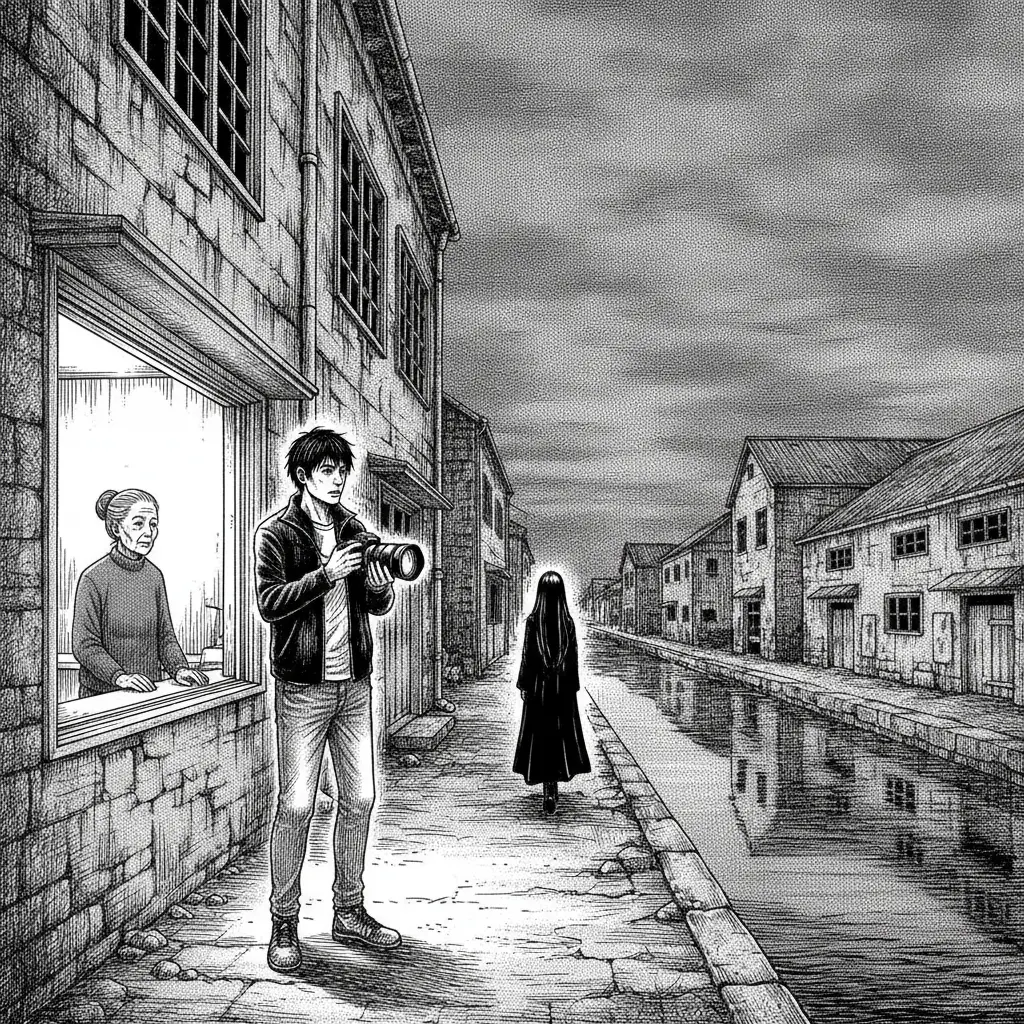
By the time I arrived in Otaru at the end of October, the sky had already sunk to the color of lead.
The wind rolling in off Ishikari Bay carried the smell of salt and rust, licking its way along the cobblestones that bordered the canal. I — Endo Seiji, photographer, thirty-seven years old — had come to spend three weeks in this city on assignment from a Tokyo publisher, shooting a collection to be called "Ruins of Hokkaido." My lodgings were in an old stone building that stood right beside the canal, a converted Meiji-era warehouse, or so I was told. The bricks of the outer walls had gone black with age, and the wooden window frames had deepened to the color of amber. When the old woman at the front desk wrote my name in the register, the fingers holding the pen trembled slightly. I paid it no mind. I took it for nothing more than the trembling of old age.
The canal was beautiful. That much cannot be denied.
Walking the cobblestone promenade at dusk, I watched the water absorb the orange and violet light and ripple like molten metal. The stone warehouses reflected in the surface, their outlines as indistinct as buildings glimpsed in a dream. I raised my camera and pressed the shutter dozens of times. The tourists had already thinned out, most of them drifting back toward the center of town for dinner. What remained along the canal was myself, a few gulls, and — though I would only understand this later — one other figure.
I first noticed that figure just before the Chuo Bridge.
Near the northern end of the canal, where the row of warehouses began to break apart, a woman was standing. She wore a dark coat and stared down at the water. I could only see her from behind, but her long black hair hung against her back without stirring in the wind, plastered there like wet cloth. I thought the way she stood would make a good photograph, and I raised my camera. Through the viewfinder, her outline appeared strangely blurred. I assumed it was the lens and adjusted the focus, but that one portion of the frame — where she stood — refused to sharpen. I lowered the camera without pressing the shutter, and the woman was gone.
That night, reviewing my photographs in my room, I looked at the shots taken near the Chuo Bridge. Where the woman had been standing, there was nothing. Only the cobblestones, the water's surface, and the sky fading toward dark.
The following morning I rose early to photograph the canal at dawn.
There was fog. The dense, particular fog of Otaru, born of the Sea of Japan's moisture flowing into the city. The warehouse walls, the cobblestones, everything was muffled in white cotton; I could not see five meters ahead. Even so, the quality of the light was extraordinary, and I walked south along the promenade, pressing the shutter as I went.
As I approached the Asakusa Bridge, I heard a sound from the water.
Not rain. Not waves. Something rhythmic — a sound like something striking the surface. I leaned over the railing and peered down. The fog obscured the water, but the sound was unmistakable. Splash, splash — like a child slapping the surface with an open hand. It came from somewhere in the fog, but its direction would not hold still. I thought it was coming from the left, then it was on the right; I thought it was on the right, then it was directly below. I held my breath and listened until, at last, the sound ceased. Only the fog remained.
When I returned to the inn, the old woman at the front desk looked at me as though she were about to say something, then stopped herself.
"What is it?" I asked. She shook her head and said, "Nothing," dropping her gaze to the register. I pressed her. "I heard a strange sound out on the canal. Is there something out there?" Without looking up, she said slowly, "Water makes sounds. All kinds of things make water sound." That was all.
From the third day onward, I began walking the southern stretch of the canal, through the district where a lumber mill and coal-loading docks had once stood.
Most visitors kept to the northern warehouses, but the south had been left largely untended — the cobblestones buckled and overgrown with weeds, some of the warehouses still abandoned, their doors hanging open to reveal the darkness inside. This was exactly the kind of ruin I had come to find. I lost myself in the work.
That afternoon, I stopped in front of one particular old warehouse.
There was something on the outer brickwork. Not graffiti — letters scratched into the bricks themselves, as though carved with a fingernail. I moved closer and saw that they were names. Many of them. Most were illegible, but those I could make out were all women's names — Hana, Tome, Yoshi, Kiku — names from the Meiji or Taisho era. I photographed the wall, intending to look into it later, and made my way back to the inn.
That night, I dreamed.
I dreamed I was at the bottom of the canal. Looking up, I could see the surface far above, the lights of the city swaying and dissolving. I was not cold. I could breathe. But something else was down there with me. I could not make out its shape in the dark, yet I knew it was there. And it was watching me. Less a gaze than a weight — a pressure like deep water pinning my body in place. When I woke, I could hear the sound of the canal through the window.
On the morning of the fourth day, I stopped in at an old bookshop near the inn.
It was a small place on the ground floor of a mixed-use building along the canal, run by a white-haired man. When I told him I was looking for books on the history of Otaru, he reached to the back of a shelf and produced a thin pamphlet — something self-published, by the look of it, titled "Supplementary Notes on the Industrial History of the Otaru Canal District." Leafing through it, I found chapters on the lumber mills and the coal port, and then a section called "The Lives of Waterfront Laborers," which contained a brief passage.
From the late Meiji period through the early years of Taisho, the canal's loading docks employed a considerable number of female workers. These women performed unskilled labor — sorting coal and timber — under brutal conditions and in deep poverty, and many died young. Some, it is said, threw themselves into the canal, though records are scarce. Locally, there were those who called them "the women of the water."
I bought the pamphlet and returned to the inn.
From that night on, I saw the woman's shadow every evening.
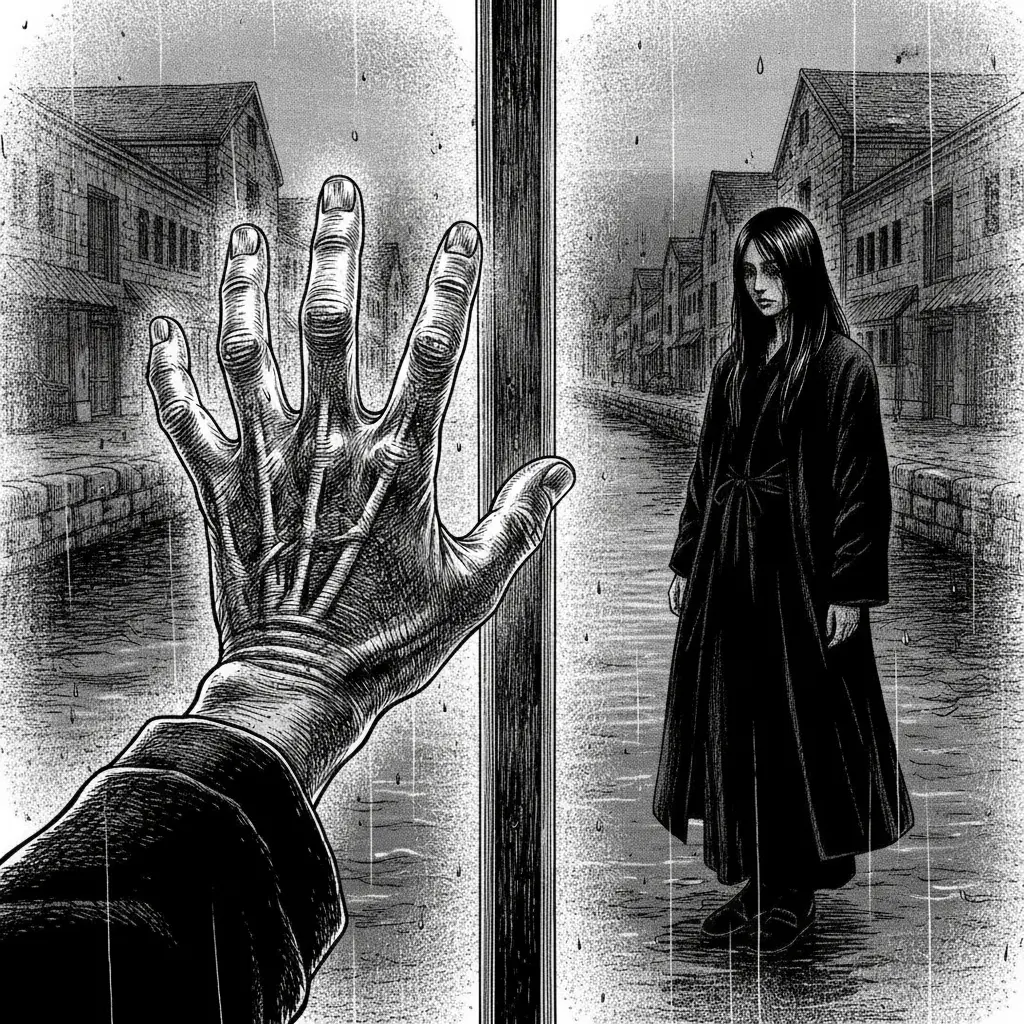
Always at dusk, always somewhere along the canal — standing still. Sometimes it was not a dark coat but something that looked like a dark kimono. When I moved toward her, she vanished. When I raised my camera, she did not appear in the frame. When I tried to observe her from a distance, she never once turned to face me. She was always looking at the water.
On the sixth night, I saw her face for the first time.
I was photographing the water's surface from the Chuo Bridge when her face appeared reflected below — a white face, turned upward. I looked down instinctively, but the surface held nothing. There was no one on the bridge, no one nearby. Yet the expression on that face would not leave me. It was neither grief nor anger. It was the face of something waiting. The word that came to me was hunger, but not hunger for food. Something more elemental — a hunger for existence itself.
On the seventh day, I tried to get the old woman at the inn to talk.
After dinner I approached her at the front desk. "Is it true that a woman appears at the canal?" She regarded me for a long moment. Then she said, "Appears is not quite right. Remains would be closer." "Remains?" "They never left, you see. They had nowhere to go." I started to ask what she meant, but she closed the register and withdrew to the back.
On the morning of the eighth day, going through my photographs, I noticed something.
In every photograph taken from the third day onward, the same element appeared. Not in pictures of the canal's surface — in pictures of warehouse walls, of cobblestones, of the sky — somewhere in the frame there was a dark, water-like pattern. At first I thought it was a smudge or a lens flare, but it was neither. Each time, it appeared in roughly the lower third of the frame, and day by day it was spreading — slowly, incrementally — upward.
I disassembled the camera, cleaned it, replaced the lens. The photographs I took the next day showed the same pattern.
On the evening of the ninth day, I returned to the abandoned warehouse in the south.
I stood before the wall of carved names and photographed it again in the late light. The setting sun stained the cobblestones red, and the shadow of the warehouse stretched long across the ground. When I lowered my camera, the warehouse door swung slowly open from within.
The wind, I told myself. It must have been the wind.
But the door opened against the direction of that day's wind. As though pushed from inside.
I stood before the doorway and looked into the darkness. The interior was bare, the floor scattered with old timber. The roof had a hole in it, and the last of the daylight fell through in thin, pale shafts. In those shafts, dust was moving. No — not dust. The movement was wrong. Dust moves in disorder; these particles turned slowly, steadily, in a spiral. As though suspended in water.
I stepped inside and raised my camera.
At the moment I was about to press the shutter, I saw something at the far end of the warehouse.
Beyond the stacked timber, someone was standing. A woman in a dark kimono. Her back was to me. Her black hair swayed, though there was no wind. I held my breath. The woman began, slowly, to turn.
I lowered the camera and walked out of the warehouse. Then I ran. I nearly stumbled on the uneven cobblestones, but I ran all the way to the Chuo Bridge. I stopped there and looked back. The warehouse door was closed.
That night in my room, I opened the photographs I had taken.
There were three shots of the warehouse interior. The first: timber and shafts of dusty light. The second: the same composition, but something like a human shape visible in the depths. The third — I looked at the screen and could not move for a long moment.
The third photograph showed the woman's face.
A face in the act of turning. The eyes were directed at the camera. But they were not ordinary eyes. There were no irises — only two white ovals, blank and pale, looking out from the frame. And half the face was wet. The hair, the shoulder of the kimono — all of it appeared soaked, as though water were dripping from every surface.
I called my editor in Tokyo immediately and told him I was unwell and suspending the shoot. I planned to leave on the first train out of Otaru the next morning. As I packed, I looked at the photograph again and again. Each time I looked, the woman's expression seemed to have changed.
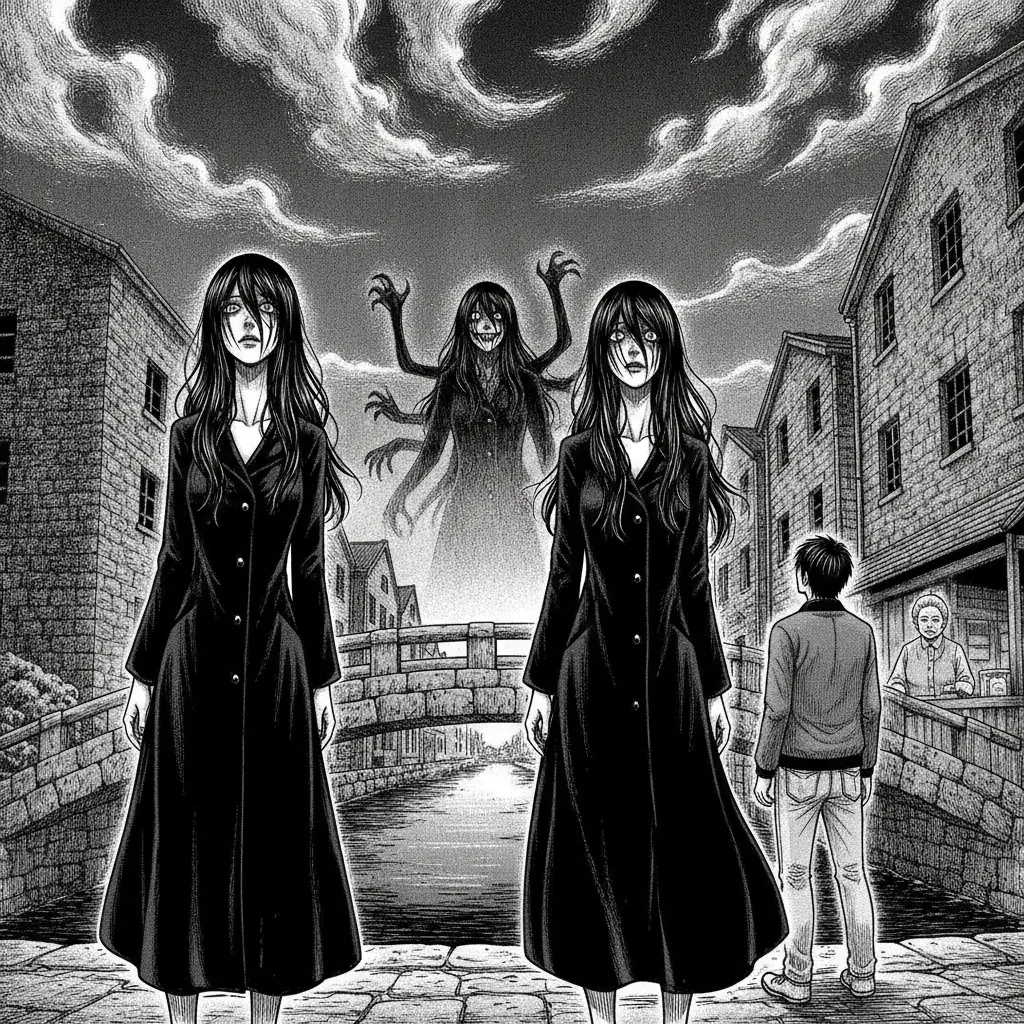
The first time, she appeared to be waiting for something. The second time, her mouth seemed to have opened slightly. The third time, that mouth appeared to be smiling.
I deleted the photograph.
The next morning I woke at four o'clock.
Outside the window it was dark, and I could hear the sound of the canal. My bags were already packed. I had two hours before I needed to leave. I lay in bed and stared at the ceiling.
The sound of the water grew louder.
No — not louder. Closer. It was no longer coming from outside the inn. It was coming from the corridor. Splash, splash — the same sound I had heard at the Asakusa Bridge, that sound of something striking water. And it was moving toward me down the hall.
I could not move.
The sound stopped outside my door. Light leaked through the gap at the bottom — not the white fluorescence of the hallway, but something that might be called black light, an absence of light, seeping in beneath the door. And then water followed it.
Just a trickle. A single thread of black water crept in under the door, found the grain of the wooden floor, and began moving toward my bed.
I threw myself out of bed, grabbed my bags, and left the room.
The corridor was empty. There was no water.
At the front desk, the old woman was there. Sitting before the register at that hour of the morning. When I appeared with my luggage, she showed no surprise. "You're up early," she said. "I'm leaving," I said. "I'll wait somewhere until the first train." She nodded. I settled my bill and was heading for the door when she called after me.
"Endo-san."
I turned.
"They only want their names to be remembered," she said quietly. "Names that no one has spoken aloud for a very long time."
I had nothing to say.
Outside, fog had settled over the canal. The cobblestones were wet, and the light from the street lamps trembled in the puddles. I started toward the station, walking quickly, watching my footing on the uneven stones.
When I crossed the Chuo Bridge, I kept my eyes away from the water.
But halfway across, I looked anyway.
The surface was still. It gleamed black in the fog. Nothing was reflected there. Or rather — the only thing reflected was my own face. My face, and behind it, faint in the fog, the outline of something.
I ran.
On the platform at Otaru Station, waiting for the first train, I took the memory card out of my camera. I could not stop thinking about the photograph I had deleted. I put the camera away in my bag, closed my hand around the memory card, and waited for the train.
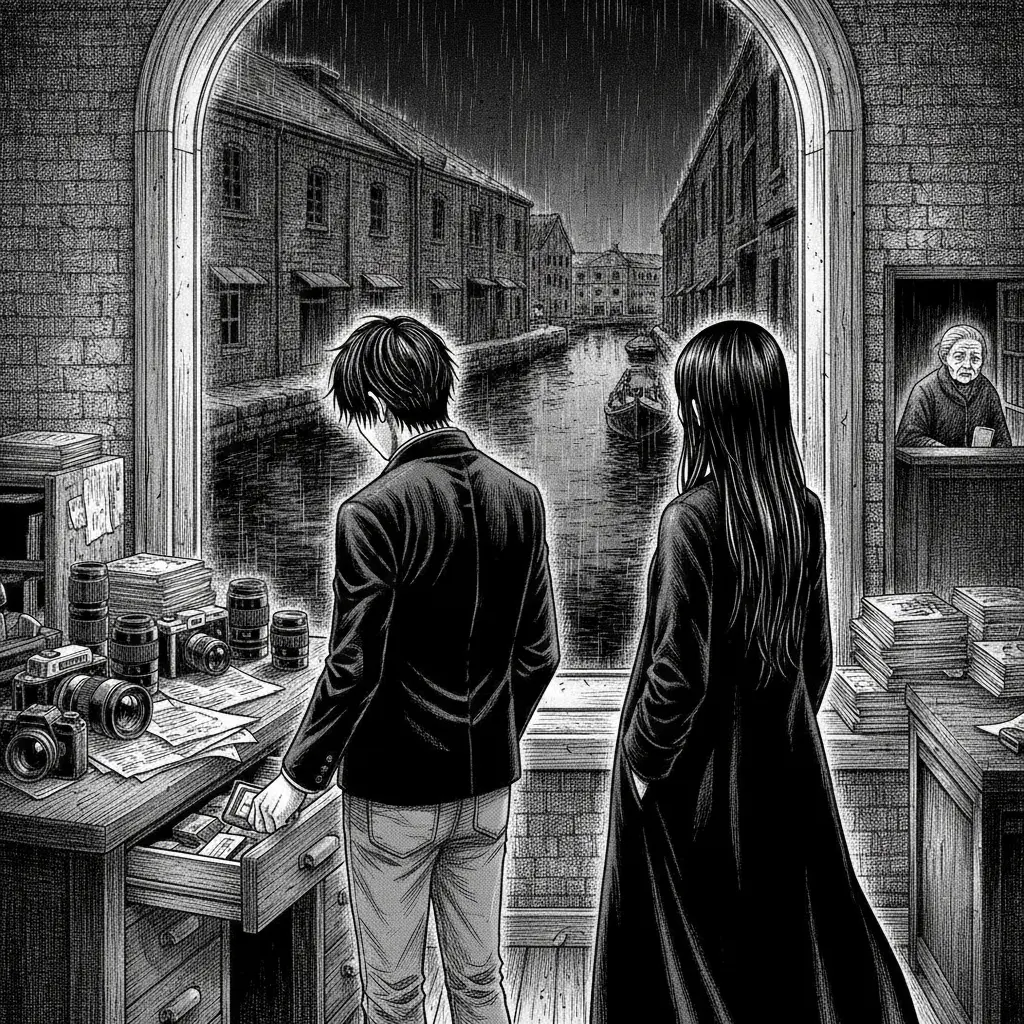
After I returned to Tokyo, I put the memory card in the back of a drawer. I did not open it. One week passed, then two, then a month. I worked. I took other assignments, ate my meals, slept.
But I began to dream.
Not the dream of the canal's bottom — something more specific. A dream of names carved into brick. Hana, Tome, Yoshi, Kiku. In a dark warehouse, someone is calling those names. The someone is me. In the dream I move toward the back of the warehouse, calling each name in turn, and each time I call one, something stirs in the darkness.
Three months later, on New Year's Day, I opened the drawer.
I inserted the memory card into the camera and turned it on. The deleted photograph was gone, of course. But there was one photograph on the card that I did not recognize.
The timestamp read 4:17 a.m. on the morning I had left Otaru.
At that hour I had been fleeing down the corridor, and the camera had been inside my bag. I had no memory of pressing the shutter.
The photograph showed my room at the inn.
The bed was in the frame — the bed where I had been sleeping. On that bed, a woman was sitting. Dark kimono, long black hair, facing the camera. Her face was clearly visible this time.
She had eyes. Dark, ordinary eyes.
But her expression was beyond my understanding. Not grief, not anger, not a smile. Only a quiet, fixed attention directed at something. Her gaze was not aimed at the camera. Her eyes were focused slightly above the lens, just outside the frame.
She was looking at whoever had been holding the camera.
I closed the photograph.
Then, slowly, I understood.
At 4:17 that morning, I had already fled the room. The camera was in my bag. No one was holding it.
Then who had pressed the shutter?
I opened the photograph again. I wanted to look once more at what she was looking at.
But then a thought came to me. Was there something else in the photograph — something behind the woman, outside the window? The canal, blurred in fog, and the cobblestones, and —
I saw what was there, and I closed the camera.
Since then, I have not visited any city with a canal. In any city, I keep away from the water's edge. The dreams continue, but I have grown used to them. The dreams were never the real problem.
The real problem is that I recognized what was reflected in the window of that photograph.
It was my face.
Looking in from outside, through the glass, into the room.