

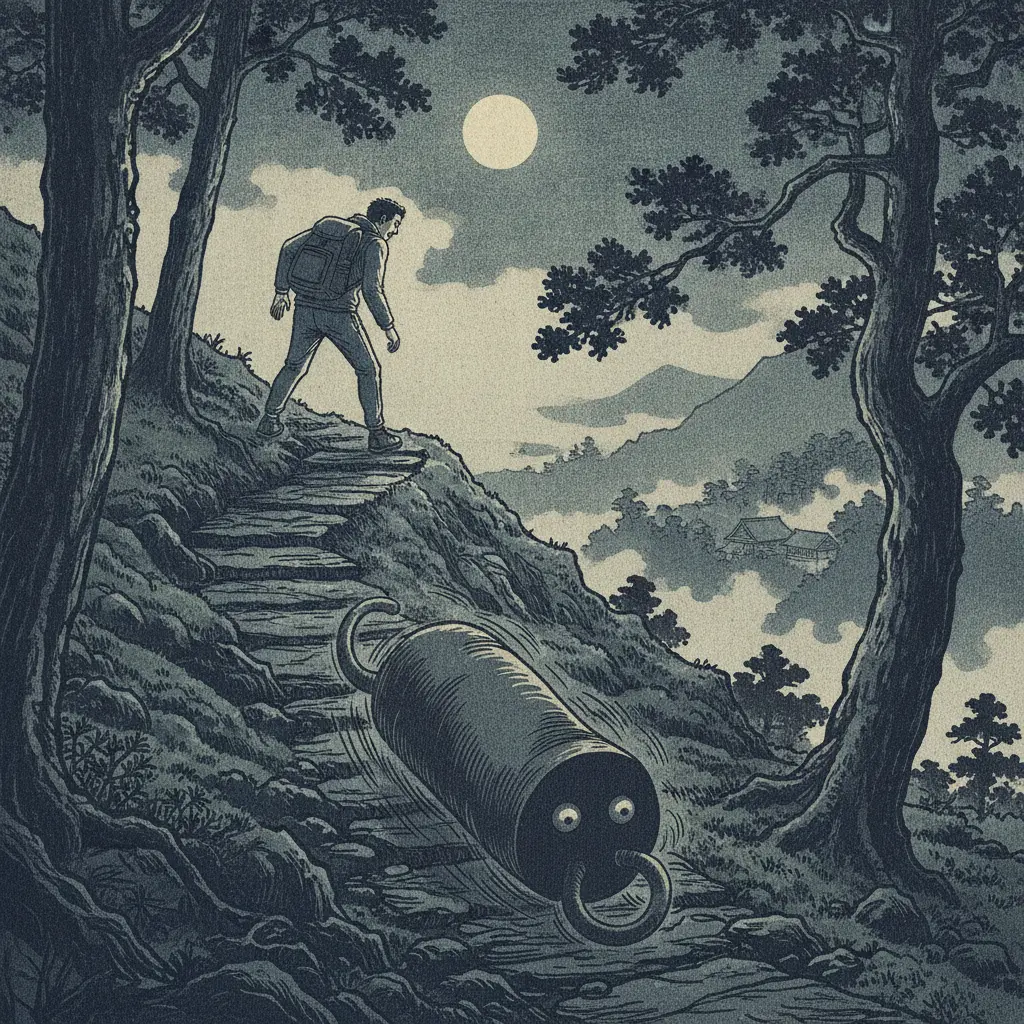
Tsuchinoko (Child of the Mallet)
Tsuchinoko (Child of the Mallet) is a snake-like creature of Japanese folklore known throughout the country, said to possess an abnormally swollen, mallet-shaped body unlike that of any ordinary snake. Recorded as early as the 1712 work Wakan Sansai Zue under the name "Nozuchi-hebi," it is reputed to bite human legs and pursue people down slopes at remarkable speed.
If you hear something rolling, never look to the bottom of the slope.
A grotesquely swollen body like a wooden mallet, blinking eyelids, a throat that cries out in a thin, reedy *chee*——this creature possesses things no ordinary serpent should. On stone tools unearthed from Jōmon sites in Gifu, along the rims of pottery from Nagano, shapes uncannily resembling its silhouette have been carved into the clay, and the memory of human dread at this shadow reaches far deeper than the written word.
In the *Kojiki* of the Nara period, a deity of the fields is recorded as *Nozuchi*——Spirit of the Wild Ground——and the 1712 encyclopedia *Wakan Sansai Zue* christened it the *Nozuchi serpent* and set down its terrors in meticulous detail: its mouth is wide enough to bite a man's leg clean through; on a downward slope it pursues a person with terrible speed. If you must flee, flee uphill. For reasons no one has ever explained, it climbs with agonizing slowness.
Nearly forty names for it are preserved across the country. In the Tōhoku region they call it *Bachi-hebi*; elsewhere it goes by *Nozuchi*, *Tatekurikaeshi*, *Tsuchi-korogi*——as many names as there are people who once saw it. The image of it seizing its own tail in its mouth and rolling like a hoop, or inching forward in the hunching rhythm of a looper caterpillar, appears again and again——but only in the testimony of those who claim to have witnessed it themselves.
What it is drawn to is strangely, precisely specific. Sake, dried squid, miso, and the smell of human hair scorched over a flame. Use these four things to bait a trap, the old men of the mountains were said to advise. It is also said to carry a lethal venom——though the accounts of those who were bitten have a way of breaking off before they reach the end.
The rumors still drift through mountain villages. Municipalities have posted reward money; every piece of "evidence" brought forward has turned out to be some other creature entirely; and still the sightings do not cease. For a case of mistaken identity, the details match one another far too precisely.
AI Auto-generated by AI — text and any images are AI-generated fiction based on folklore and rumors, not a record of real events.
Think this entry is wrong or out of date? Re-investigate — we’ll re-read the source (Wikipedia) and refresh it. Once a day per entry.
Source: ツチノコ — Wikipedia (ja.wikipedia.org). Adapted and reconstructed by this site. License CC BY-SA 4.0.