

Hwaseong Fortress Night Tales — The Voices Sleeping Beneath the Walls
Suwon Hwaseong is a fortress located in Suwon, South Korea, built during the Joseon Dynasty, and is said to be a site where the voices of laborers who worked on its construction still linger within the stones of its walls.
By day, a UNESCO World Heritage Site under careful protection; by night, something is said to hold its breath within the cracks of the ramparts.
Construction of Suwon's Hwaseong Fortress (수원 화성) began in the eighteenth year of King Jeongjo's reign (1794) and was completed in a mere two years — and it is said that within that brief span, the sweat and toil of tens of thousands of hands seeped into every one of its 5.74 kilometres of stone. Among the old-timers of Suwon, a quiet story has long circulated: that if you press your ear to certain stretches of the wall, you can still hear the sounds of the labour gangs who once hoisted great blocks of granite with their geojunggi cranes and their yuhyeonggeo wheeled carts.
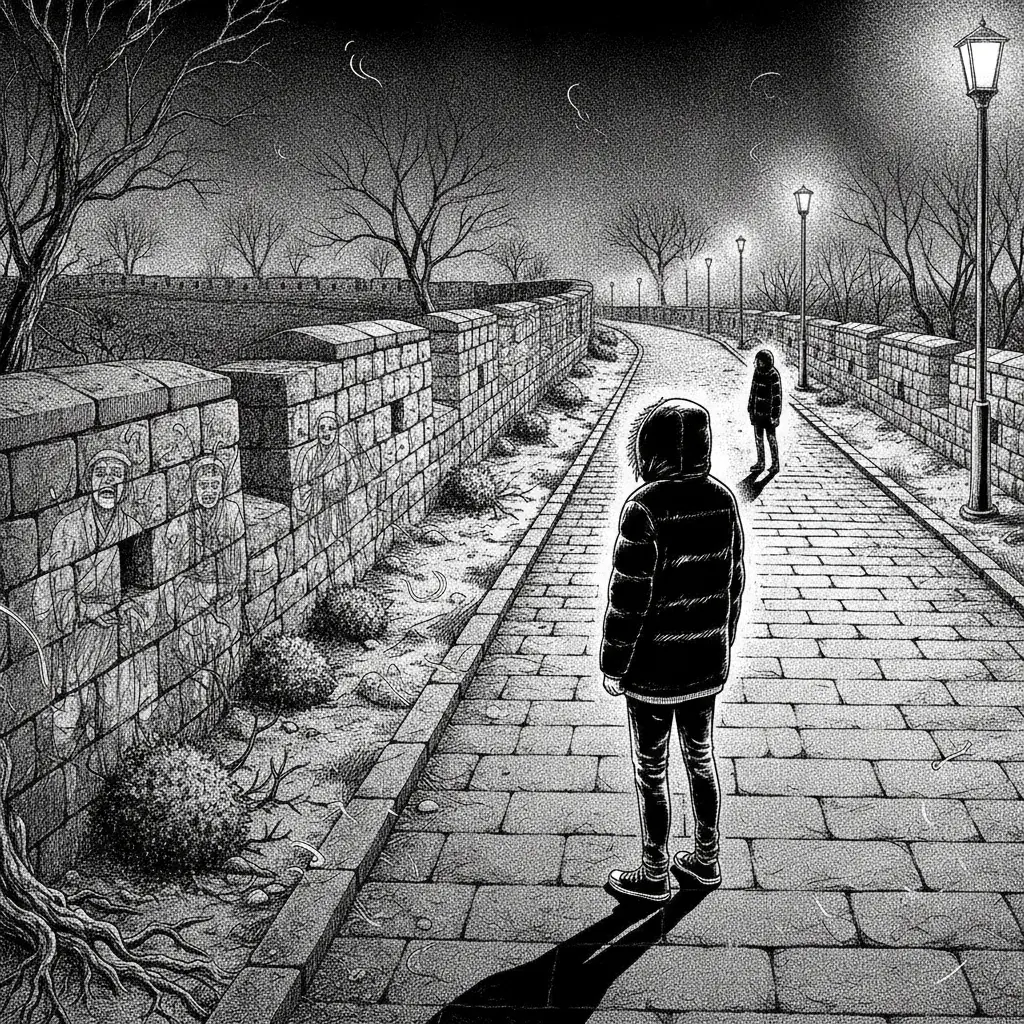
Near the hidden postern gate (암문) on the southwestern face of Paldal Mountain, it is said that as the night deepens, a faint breath seeps out between the stones, carrying with it something like a low, murmured chant. Some visitors dismiss it as a trick of the wind, but the old storytellers whisper otherwise — that these are the laments of labourers who died during construction, souls whose fates went unrecorded even in the official royal protocols, and who remain sealed inside the rock.
During the Korean War, artillery fire brought down portions of the fortress wall; what followed was a painstaking restoration guided by the Hwaseong Fortress Construction Report (『화성성역의궤』). Yet it is along the boundary between the restored sections and those of original stone — the so-called "seam zones" — that photographs are said to occasionally capture unidentifiable human silhouettes. Reports surface intermittently on online communities. Whether any of it is true has never been confirmed.
The rampart promenade north of Janganmun Gate is, after sunset, a place of conspicuous darkness: the spacing between lampposts is unusually wide, leaving long stretches swallowed by shadow. People who have walked those stretches alone sometimes report the sensation of footsteps following close behind — and every account ends the same way: they turned around, and there was no one there.
Hwaseong Fortress is a UNESCO World Heritage Site and a nationally designated historic monument, open to the public as a protected site; however, certain sections of the wall walk and areas outside managed zones are closed to visitors after dark. Unauthorised entry constitutes a violation of the Cultural Heritage Protection Act, and wandering alone beneath the darkened ramparts is — quite apart from any question of the supernatural — strongly inadvisable on grounds of safety alone.
AI Auto-generated by AI — text and any images are AI-generated fiction based on folklore and rumors, not a record of real events.
Location
Think this entry is wrong or out of date? Re-investigate — we’ll re-read the source (Wikipedia) and refresh it. Once a day per entry.
Source: 수원 화성 — Wikipedia (ko.wikipedia.org). Adapted and reconstructed by this site. License CC BY-SA 4.0.