

Ōkunoshima (大久野島)
Ōkunoshima (大久野島) is a small island in Japan's Seto Inland Sea, said to have housed the Imperial Japanese Army's sole poison-gas manufacturing facility, and is now widely known as "Rabbit Island" for the hundreds of wild rabbits that inhabit its grounds.
Beneath the soil where rabbits run, poison once lay sleeping.
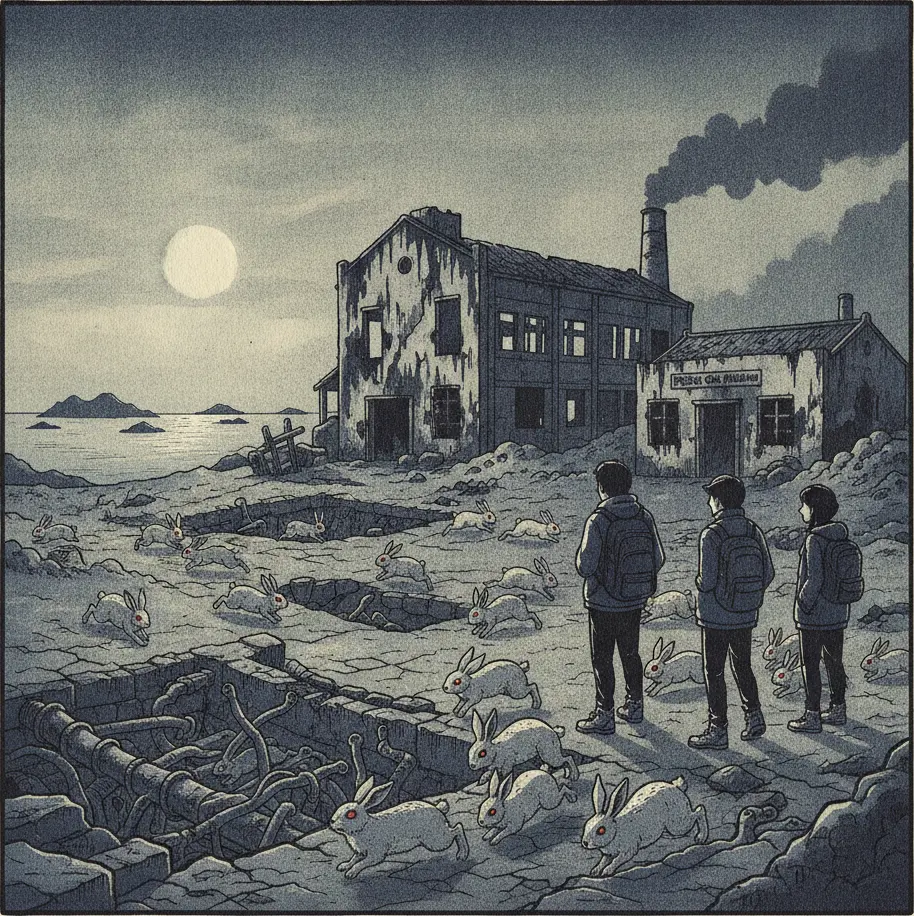
A small island barely four kilometres around, adrift in the gentle waters of the Seto Inland Sea. Today it is known as Rabbit Island, famous for the sight of hundreds of tame wild rabbits swarming around visitors' feet. Yet for a long time, a certain blank space existed on the island's maps — in the military charts of the early Shōwa era, this island had been deliberately erased.
In those same early Shōwa years, the Imperial Japanese Army established here the nation's only poison gas manufacturing facility. Mustard gas, lewisite, hydrogen cyanide — the ruins of the factory that mass-produced invisible death still stand scattered across the island, quietly rotting. The Poison Gas Museum preserves what traces remain, though some visitors say the outer walls of the building still appear to weep with something that soaked into them long ago.
Nearly all of the island is government land, and there are no private residences. The only permanent inhabitants are the staff of the holiday village — some twenty souls in all. Fresh water is carried over by boat from the mainland; the island holds none of its own. It is said that in ancient times this was one of the hills rising from a plain that would become the Seto Inland Sea, and a Naumann elephant's molar has been dredged from these waters — yet no ruins, no burial mounds, nothing of that kind has ever been unearthed on the island itself.
Why the rabbits have multiplied to such numbers, no one can say with certainty. The persistent whisper holds that they are descended from animals brought here as test subjects for poison gas experiments, though this has been officially denied. Even so, the rabbits thread their way through the stonework of the ruins, begging food from outstretched hands. Their eyes are red, and they seem to be looking at something far away — so travellers invariably say.
The regular ferry to the island departs from Tadanoumi. Mobile signals reach here, but night closes early on the island. After the last tourists have gone, what remains on the shore is the sound of waves, and the sound of countless small feet moving through the grass.
AI Auto-generated by AI — text and any images are AI-generated fiction based on folklore and rumors, not a record of real events.
Location
Think this entry is wrong or out of date? Re-investigate — we’ll re-read the source (Wikipedia) and refresh it. Once a day per entry.
Source: 大久野島 — Wikipedia (ja.wikipedia.org). Adapted and reconstructed by this site. License CC BY-SA 4.0.