

Jeongdongjin (正東津)
Jeongdongjin (正東津) is a locality on the East Sea coast in Gangneung, Gangwon Special Self-Governing Province, South Korea, said to have received its name because it was believed to lie due east of Gwanghwamun in the Joseon era, and is also known for housing what is reported to be the world's closest train station to the sea.
Where the sun touches land first, some things are said never to return.
Nestled at the far edge of the East Sea coast, in Gangdong-myeon, Gangneung City, Gangwon Special Self-Governing Province, Jeongdongjin (正東津) is said to have received its name because it lies due east — "jeongdong" — of Gwanghwamun in Hanyang, the old capital. Yet as surveying techniques grew more precise, it was revealed that the true due-east bearing points instead toward Dobongsan — the name had been misaligned from the very beginning. Among those who know this place, the fact that even its name never found its proper footing lingers as a quietly unsettling afterthought.
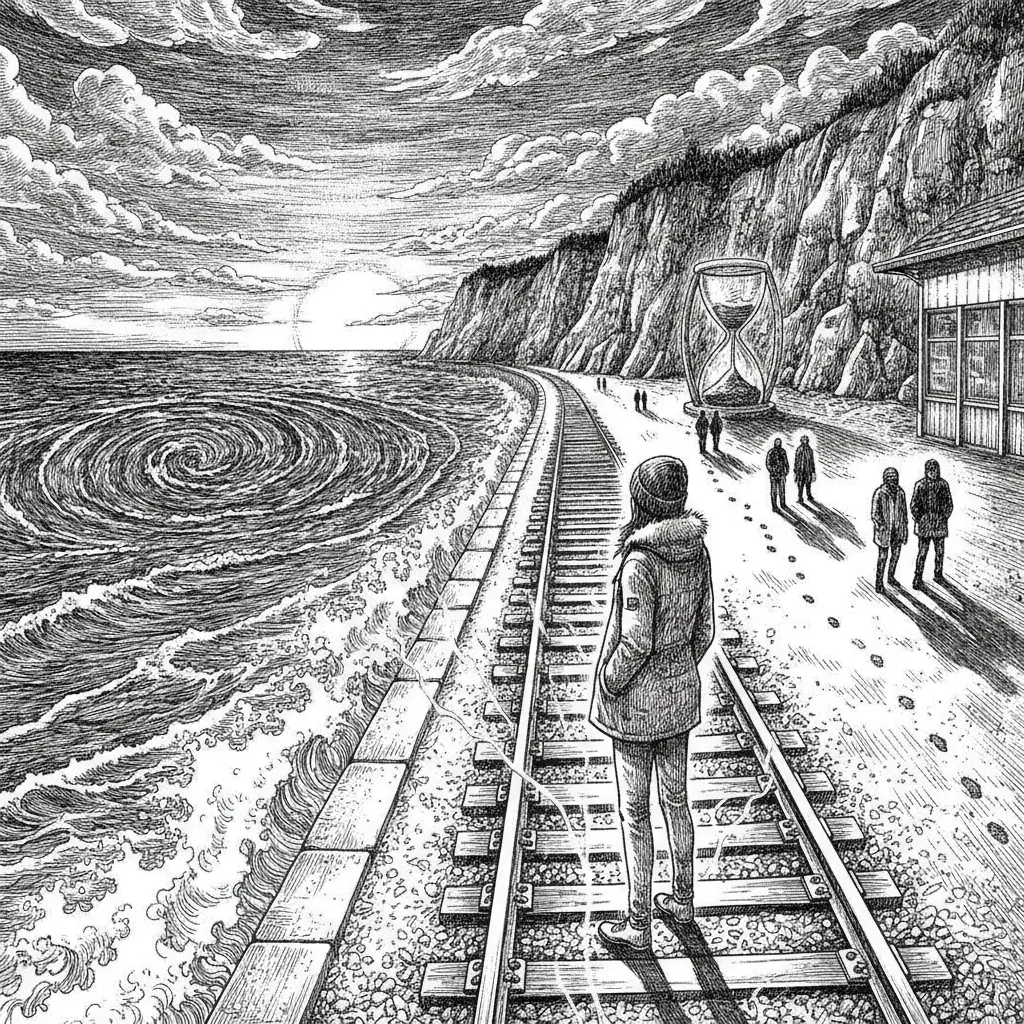
Jeongdongjin Station is said to hold a Guinness World Record as the train station closest to the sea anywhere on earth. The sound of waves washes all the way onto the platform, and after the station gained fame as a filming location for the 1994 drama Sandglass, it drew countless visitors. Yet those visitors often come back with the same story — that if you stand alone on the platform after the last train of the early morning has passed, the rails begin to tremble from the direction no train ever comes.
Jeongdongjin Beach fills to the brim each year with crowds gathered to witness the first sunrise of a new year. But in the moment just before that light crests the horizon — when the sea sinks briefly into absolute darkness — there are scattered whispers of something strange. Those who happened to glance back at the sand in that fleeting instant claim to have found another set of prints pressed neatly alongside their own.
The Jeongdongsimgok Coastal Cliff Trail and the marine terraces nearby are formations where strata laid down over millions of years have been thrust above the sea. Geologically, the landscape is a wonder — but among the older fishermen of the area, there is a careful, hushed tradition of warning that somewhere beneath those terraces, the current runs in a way that pulls at a person. Nothing officially confirmed; it lives on only as something passed mouth to mouth.
Jeongdongjin rose to fame on the back of a drama's themes of parting and waiting, and perhaps those emotions seeped into the ground itself. Every so often, posts surface in online communities from people who made the pilgrimage here on the first day of a new year and came home alone, carrying a vague, nagging sense that they had left something behind. Whether what they left was a memory, or something else entirely, no one has ever been able to say.
In the land where the sun rises first of all, does the light truly lay everything bare — or do certain things find, within that very light, a place to hide all the deeper.
AI Auto-generated by AI — text and any images are AI-generated fiction based on folklore and rumors, not a record of real events.
Location
Think this entry is wrong or out of date? Re-investigate — we’ll re-read the source (Wikipedia) and refresh it. Once a day per entry.
Source: 정동진 — Wikipedia (ko.wikipedia.org). Adapted and reconstructed by this site. License CC BY-SA 4.0.